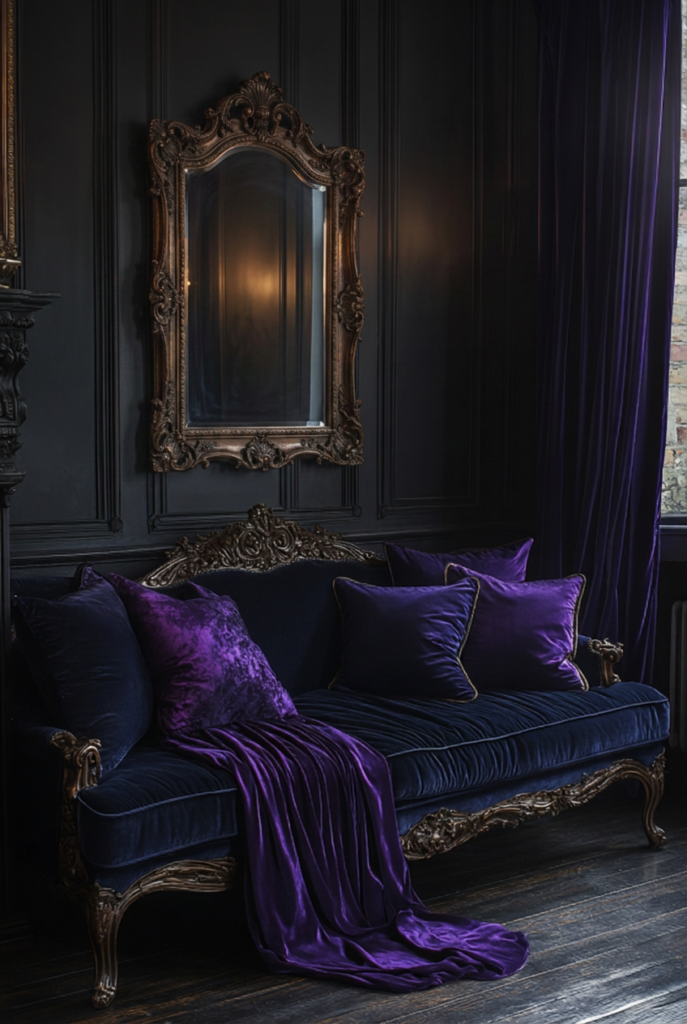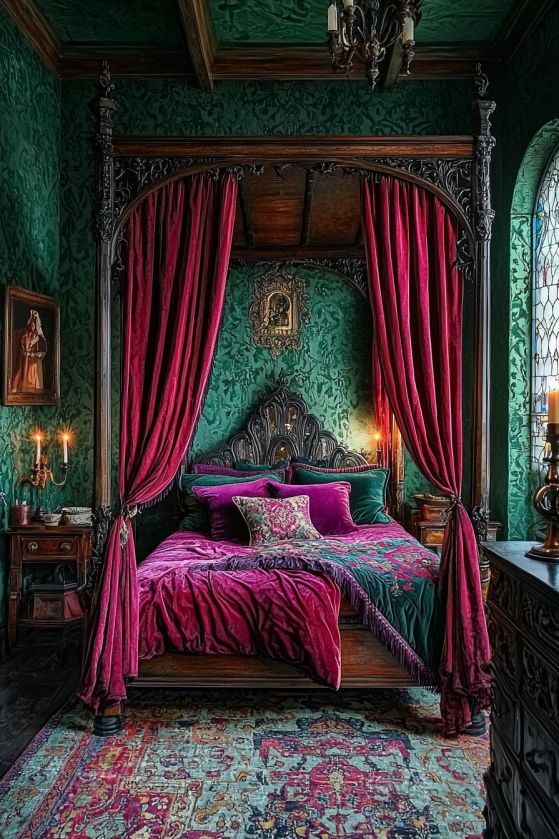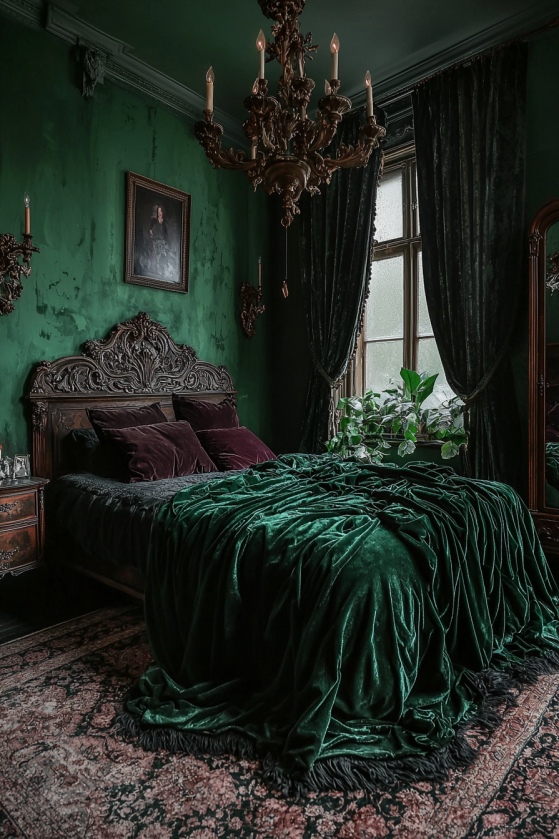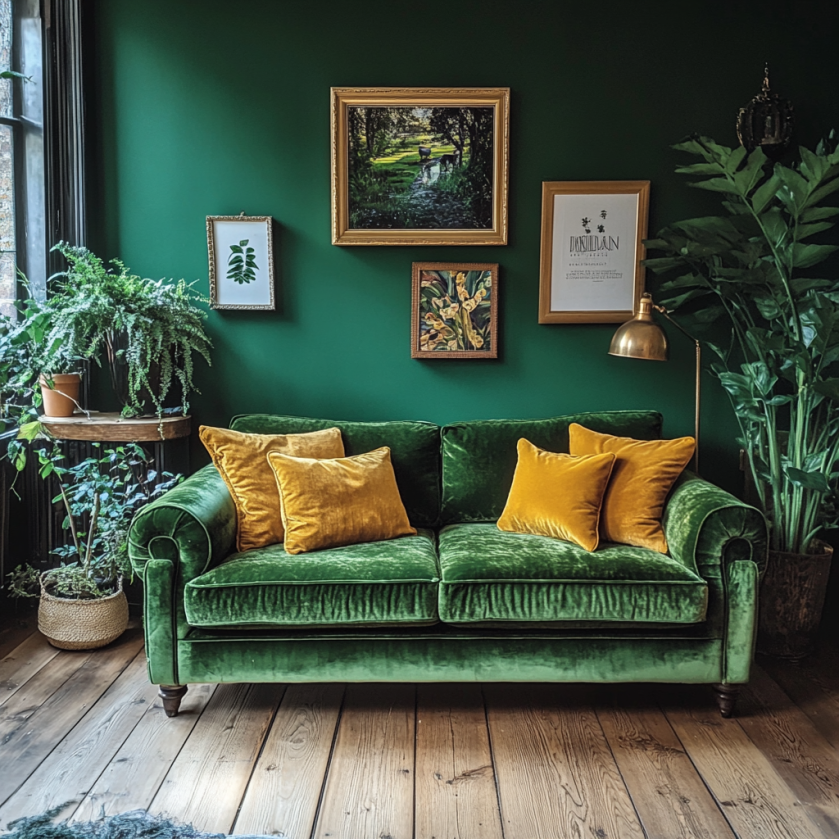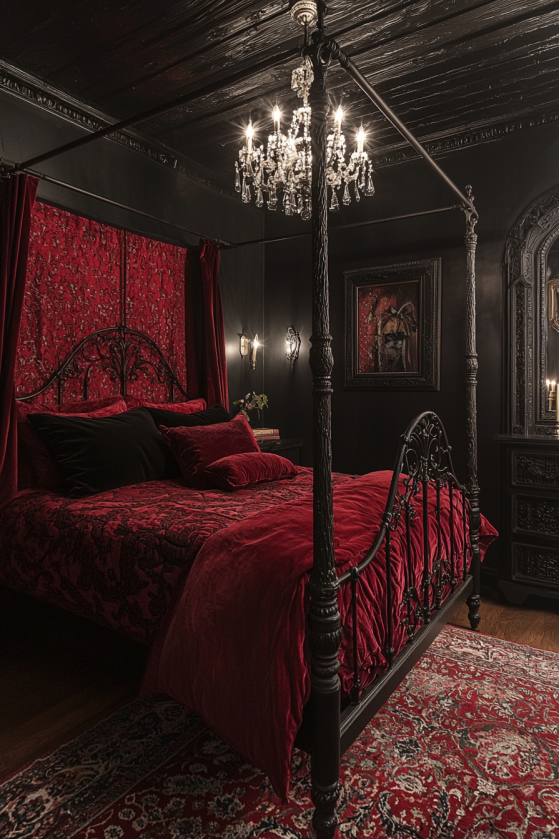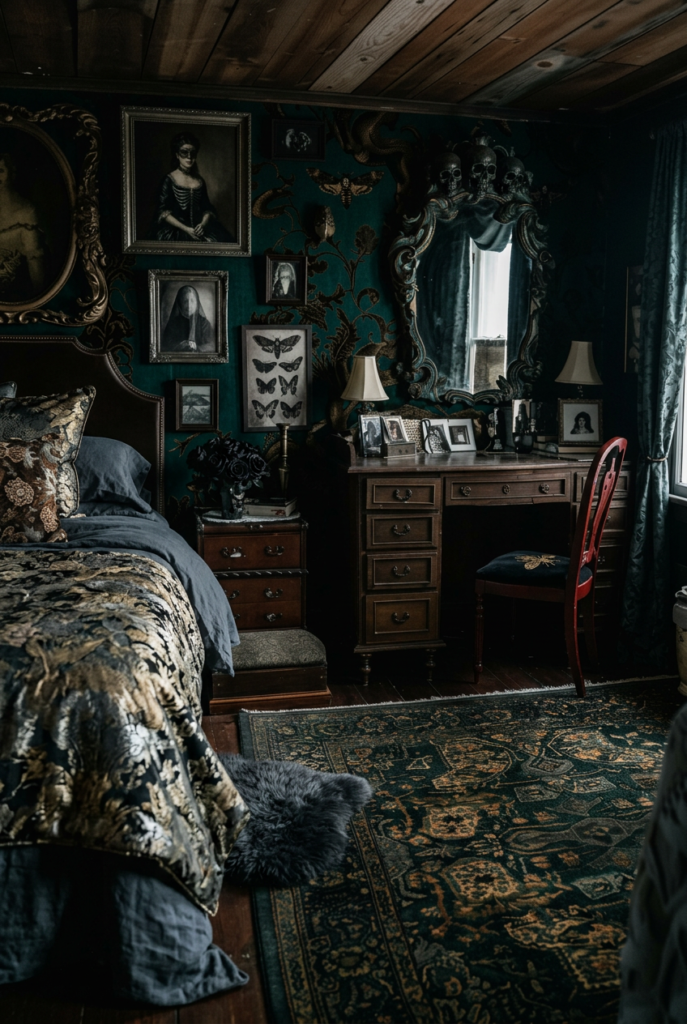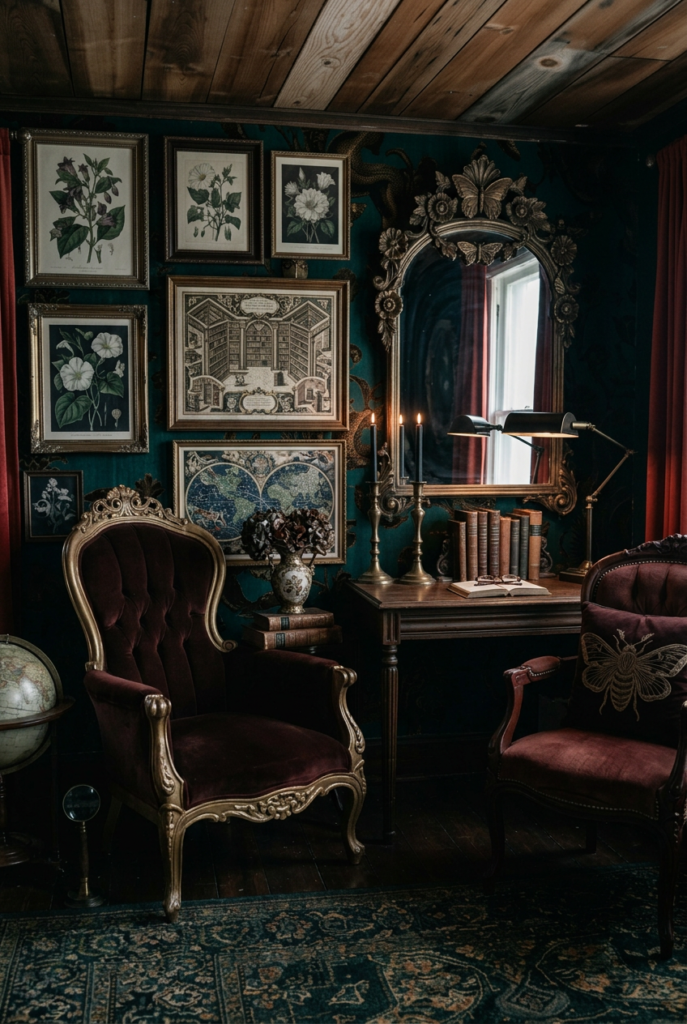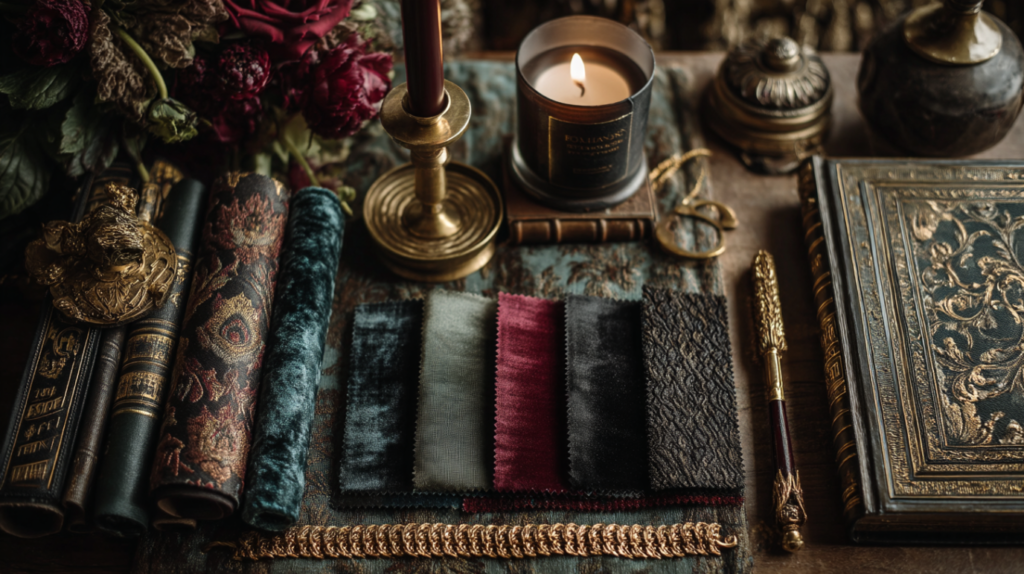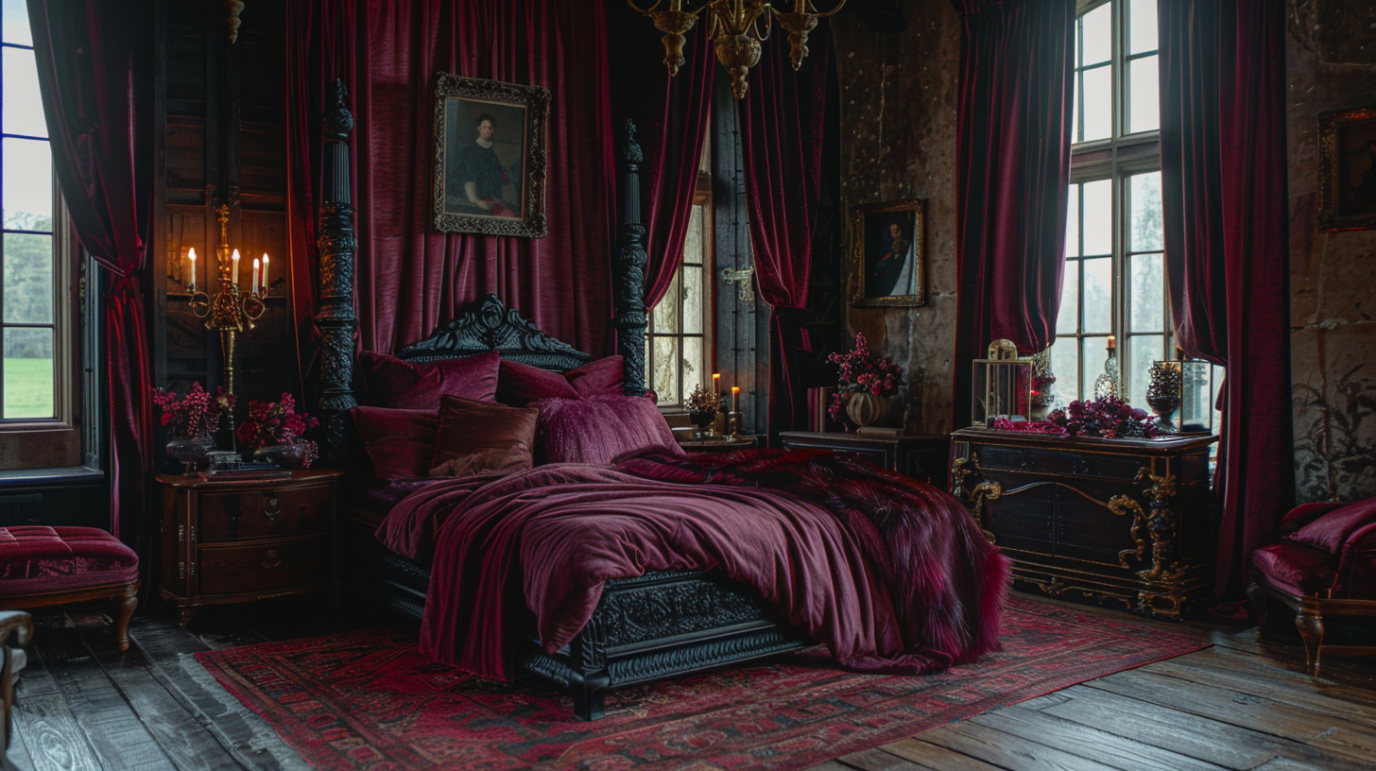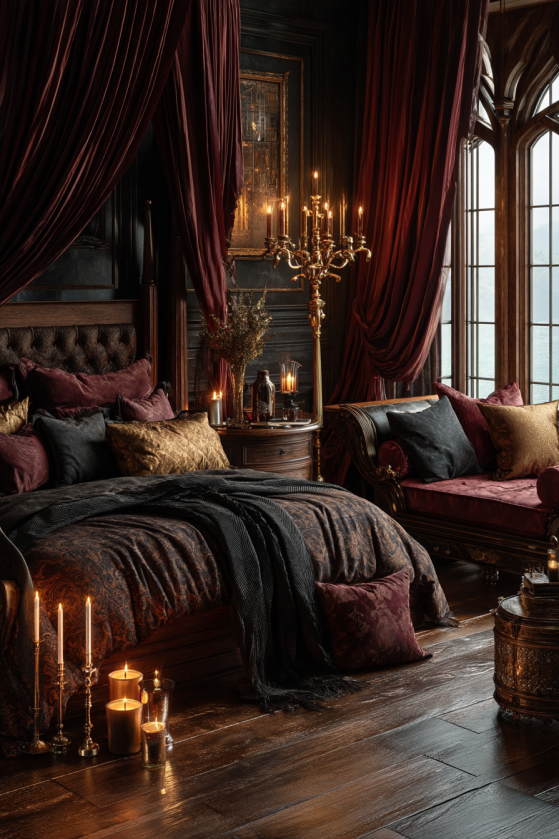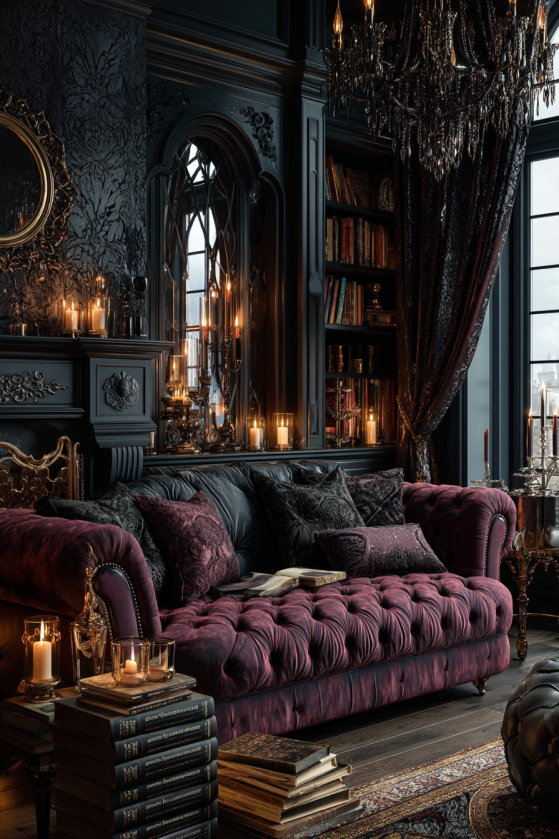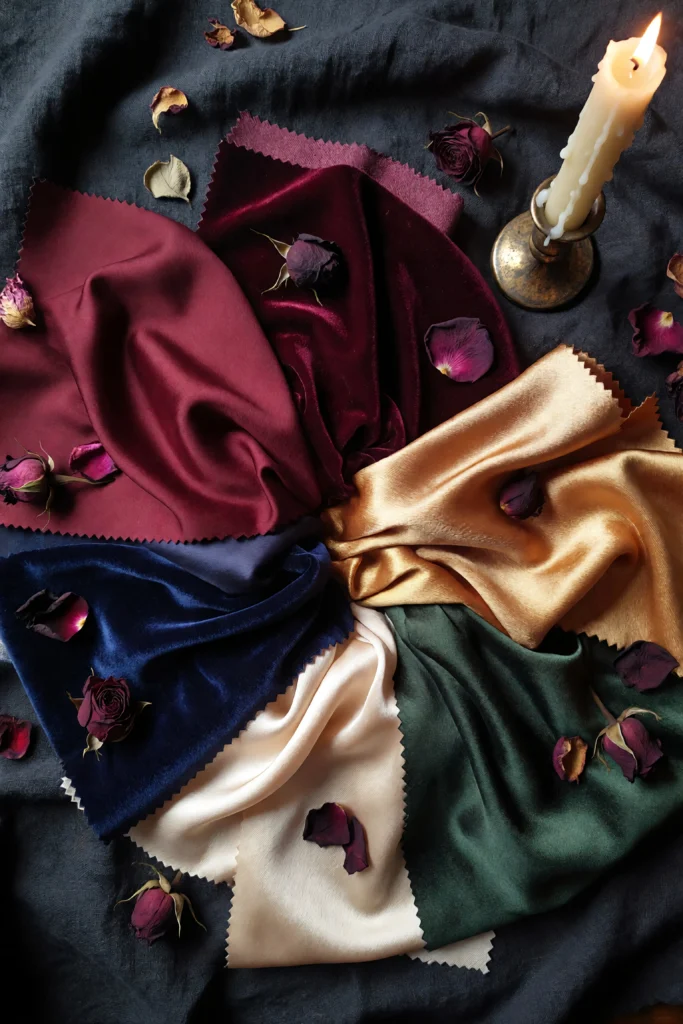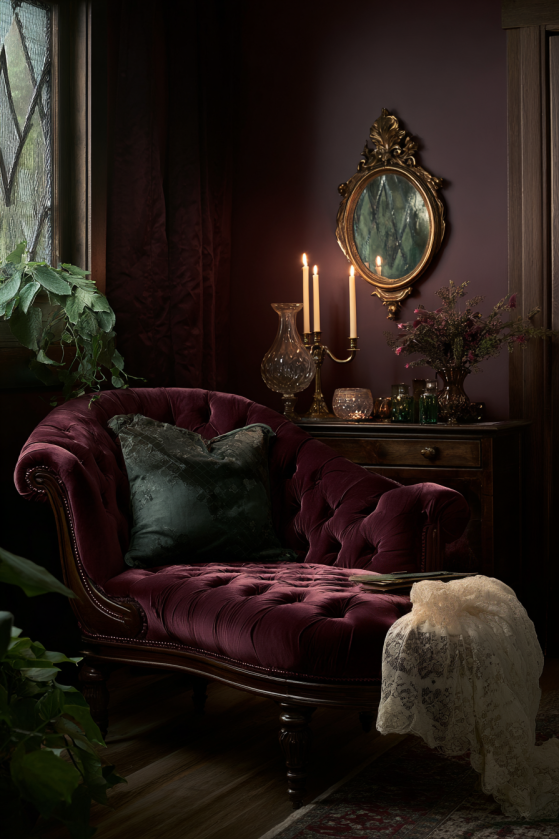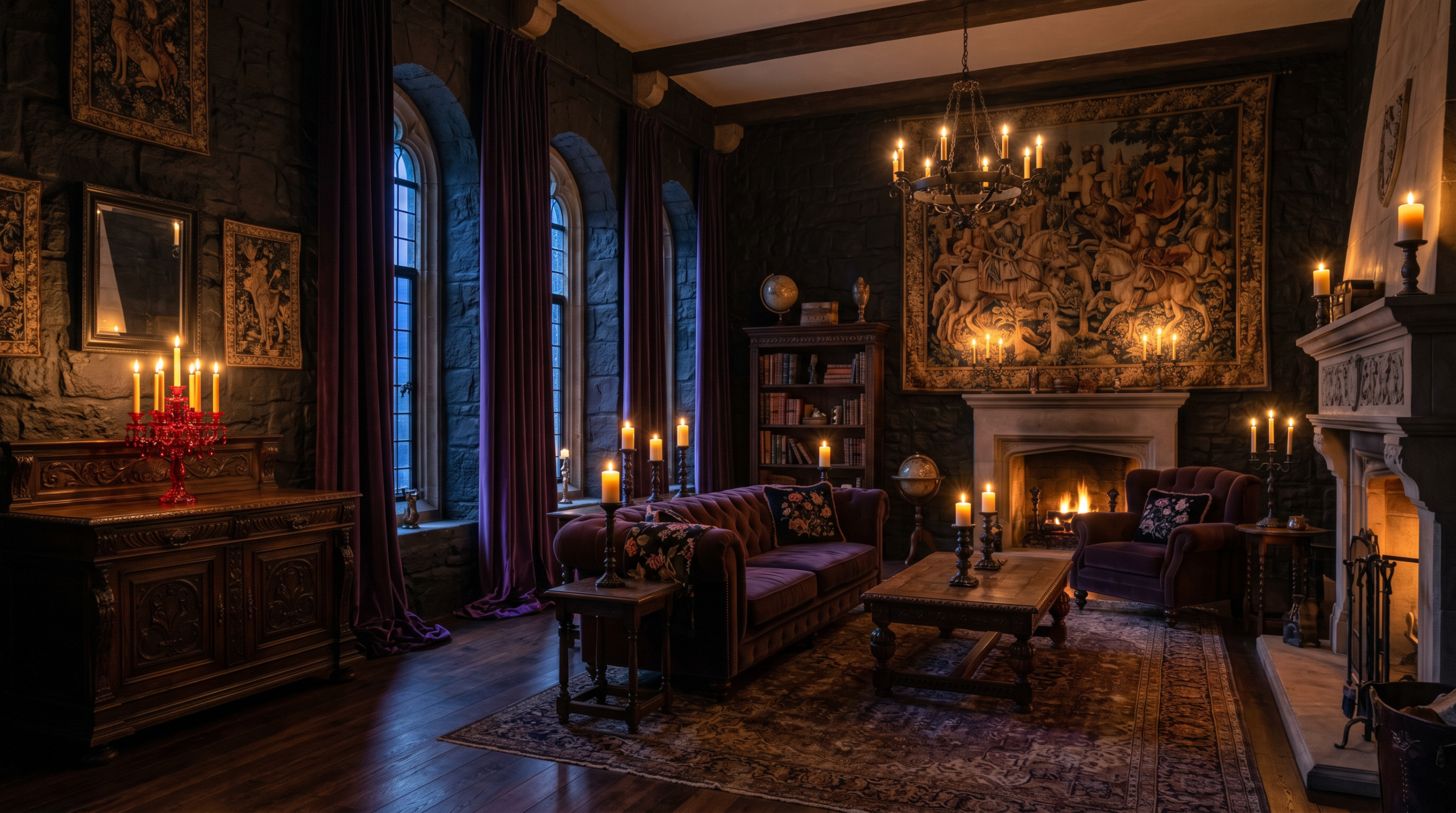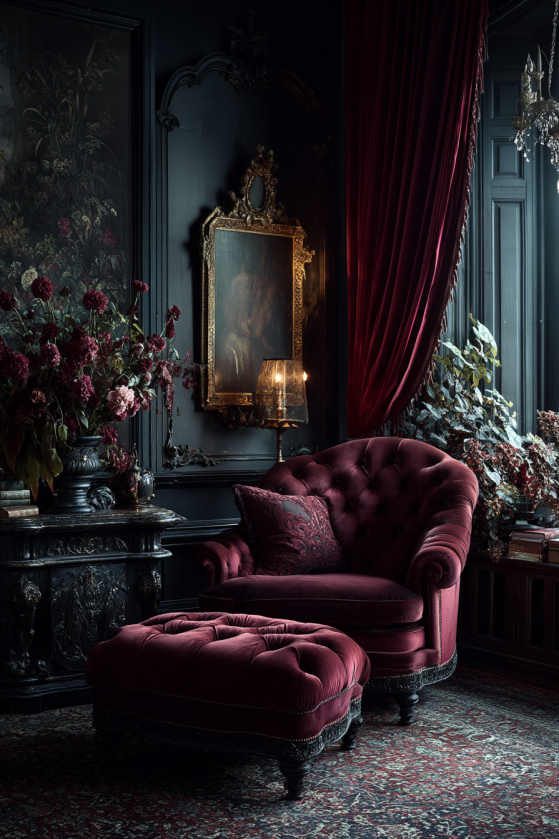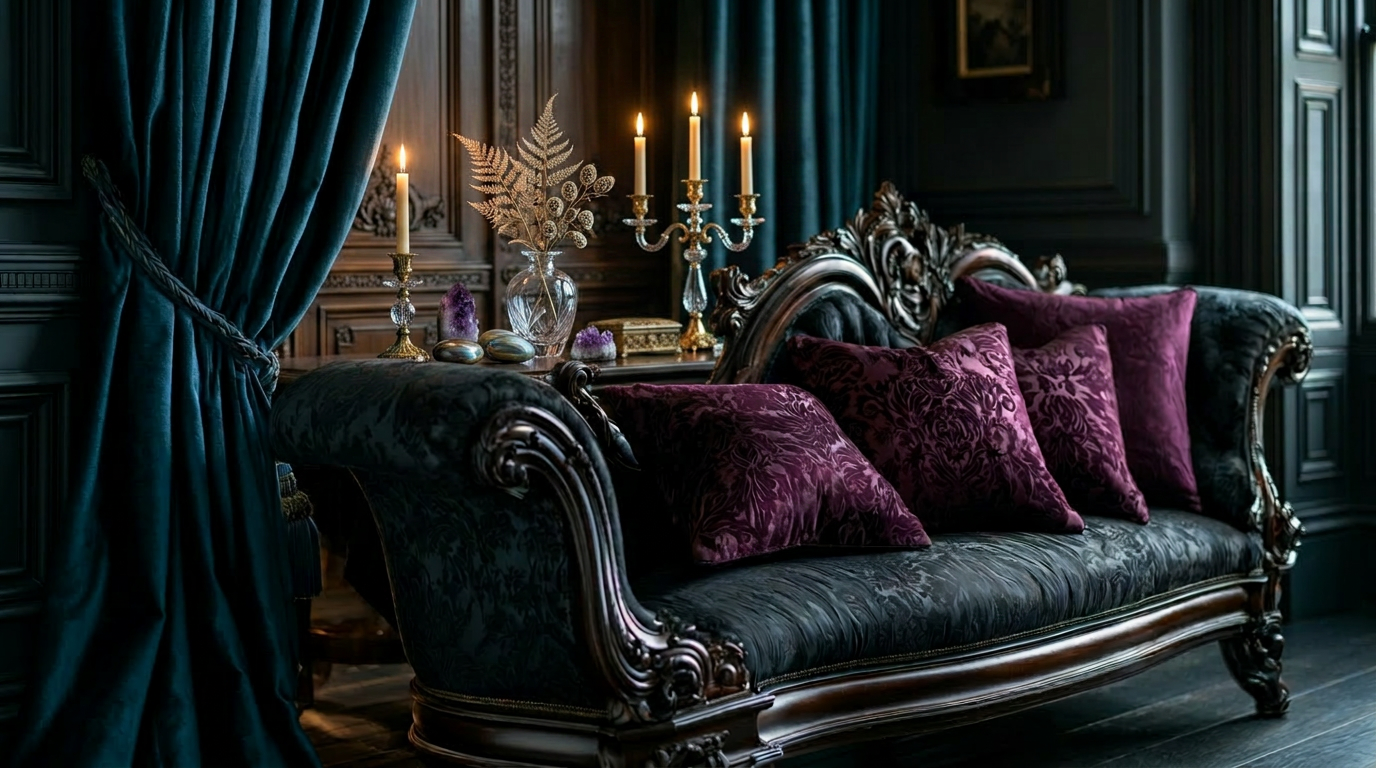
There’s a particular kind of room that stops you in the doorway. Not because it’s perfect — because it’s *alive*. Deep sapphire velvet falling in heavy pools against a dark wall. Emerald that seems to breathe in low light, shifting from forest to sea depending on where you stand. A candelabra throwing amber light across amethyst cushions, making the shadows as deliberate as the objects that cast them.
This is **jewel tone room decor** at its most intentional: not a trend to catch before it passes, but an atmosphere to construct — room by room, layer by layer — until the space feels less like an interior and more like an interior *world*.
Jewel Tone Room Decor Ideas: Start with the Walls
Jewel tone decor ideas begin with commitment. Half-measures produce muddiness, not magic. Choose one dominant jewel — sapphire, emerald, or amethyst — and let it anchor the room before you add anything else.
For a **jewel tone bedroom**, deep amethyst or plum walls create an enveloping quality that neutrals simply cannot replicate. The room contracts around you at night. In daylight, the same walls shift into something almost botanical — more violet than purple, more mineral than paint.
For a **jewel tone living room**, emerald is the most versatile entry point. It reads rich without reading gothic, and it bridges warm and cool tones in a single swatch. Pair it with brass accents and dark linen, and the room looks as though it’s always been there.
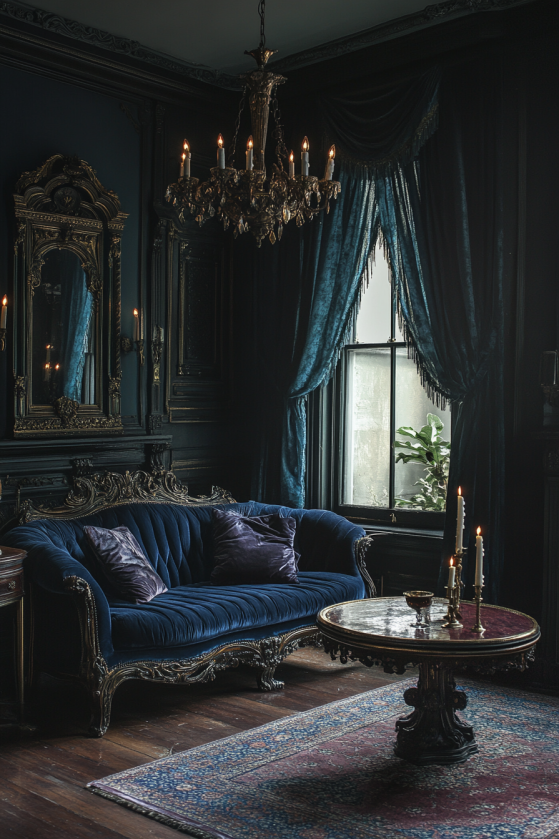
**Sapphire or emerald velvet curtains** are the single most transformative piece in any jewel tone interior. Floor-to-ceiling panels shift the entire atmosphere — by afternoon they glow; by candlelight they absorb the room. Look for panels with substantial weight and a blackout lining. The fall matters as much as the color.
*[Affiliate: Deep sapphire or emerald velvet curtains — floor-to-ceiling panels with blackout lining. Weight and drape are as important as the hue.]*
[IMAGE 2]
—
## Layer with Velvet: Pillows, Bedding, and Throw Fabrics
—
The palette is set by walls and curtains. The *mood* is made by textiles.
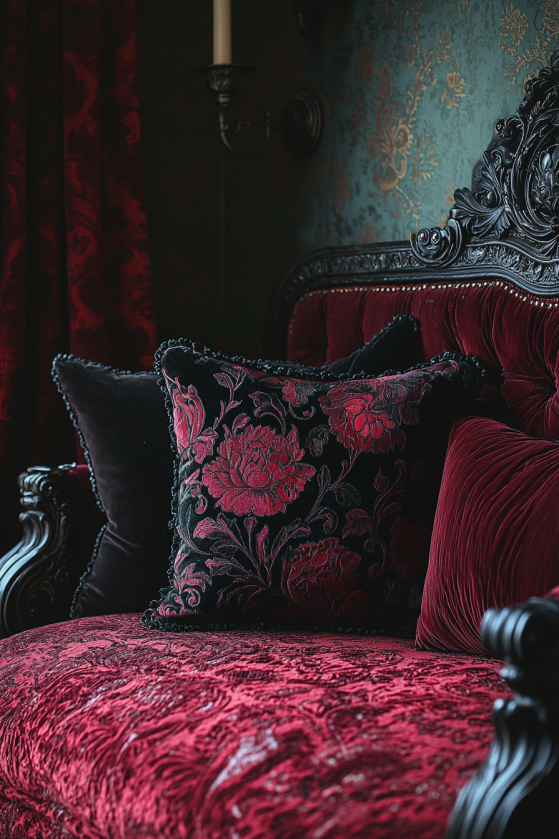
**Velvet home decor** earns its place in any jewel tone space because velvet is not neutral — it has direction. The pile catches light differently from every angle, which means a single amethyst cushion performs differently at noon and at midnight. This is what makes it indispensable in a room designed around atmosphere.
In a jewel tone bedroom, layer inward: start with deep maximalist bedding in oxblood or midnight plum, then add velvet throw pillows in contrasting jewels — sapphire against oxblood, emerald against aubergine. The mix should feel layered, not matched. A room assembled around a palette reads as *lived*; a room assembled from a single collection reads as staged.
For a jewel tone living room, a single oversized velvet cushion in ruby or deep sapphire against a dark linen sofa can define the entire space. The jewel tone does not need to be everywhere to be felt. A tufted velvet accent chair in sapphire or oxblood — positioned in a corner with a floor lamp and a trailing vine — completes the atmosphere in a way no accessory can. It’s the most-saved furniture piece across dark maximalist boards this season, and it anchors a layered jewel tone vignette with authority.
For everything that goes into building out the full look, our [dark maximalist bedroom](https://shadowcottage.com/dark-maximalist-bedroom) guide takes the jewel tone palette from idea to fully realised atmosphere.
*[Affiliate: Velvet throw pillows in sapphire, emerald, amethyst, and oxblood. Removable covers make seasonal palette shifts effortless.]* *[Affiliate: Jewel-toned dark maximalist bedding in oxblood, midnight plum, or burgundy — structured drape and high thread count.]* *[Affiliate: Tufted velvet accent chair in sapphire, emerald, or oxblood — the single most-saved furniture piece in this niche.]*
[IMAGE 3]
—
> **What’s Selling on Pinterest Right Now** > > – **Velvet accent chairs** — tufted, jewel-toned (sapphire, emerald, oxblood) — the single most-saved furniture piece across GS territory right now > – **Ornate candelabras & taper candle sets** — velvet-draped, candlelit rooms are the defining visual of the season; deeply shoppable > – **Crystal & antique-style chandeliers** — rising across gothic maximalist, opera aesthetic, and jewel tone boards simultaneously > – **Antique bar carts** — +100% Pinterest search growth; highly giftable, strong affiliate margin > – **Jewel-toned velvet throw pillows & curtain panels** — emerald, plum, sapphire — the highest-volume shoppable textile in the niche right now
—
## Objects That Hold the Light
—
A jewel tone room is not finished with paint and pillows. It requires objects that catch and hold the light — that give the room something to do after dark.
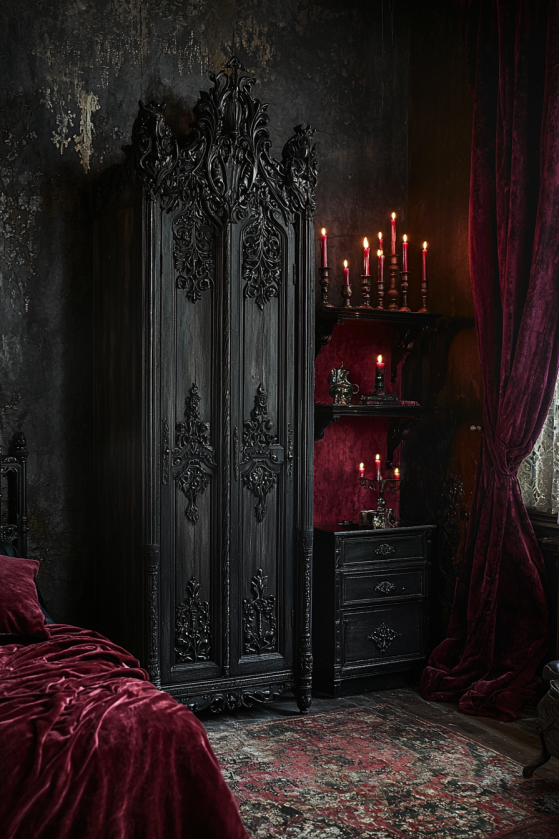
An **ornate candelabra** in aged brass or blackened iron is the defining accent piece in a dark maximalist interior. Lit, it transforms any corner into a focal point. Unlit, it holds form as a sculptural presence. Place tapers in deep burgundy or black; even the color of an unlit candle reads as part of the object.
**Crystal accent pieces** — cut-glass decanters, amethyst clusters, dark-faceted candleholders — scatter light across a jewel tone space the way the stones themselves scatter light: fractured, unexpected, beautiful. A cluster on a dark shelf or a single decanter on a mantel is enough. Restraint makes each piece land harder.
An **antique bar cart** in brass or blackened metal earns its place here as a styled surface rather than a functional one. Arrange it with a crystal decanter, black taper candles, and a trailing vine, and it becomes the room’s most photographic corner — a jewel tone vignette in miniature. Pinterest search for antique bar carts has grown over 100% this season; the margin is strong and the giftability is obvious.
A **crystal or antique-style chandelier** — faceted glass, aged brass or gold finish — pulls the entire jewel tone palette upward. When the light catches it, it multiplies every jewel in the room. This is the piece rising simultaneously across gothic maximalist, opera aesthetic, and jewel tone boards alike.
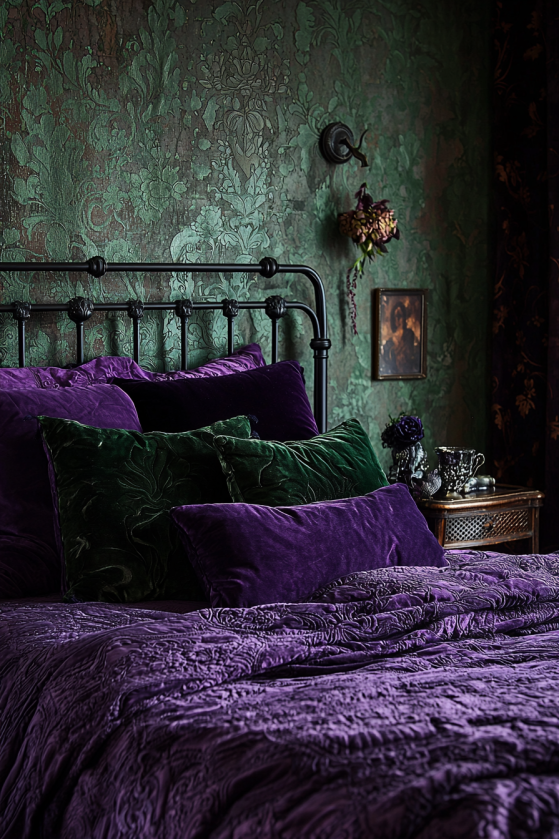
For walls, **dark maximalist wallpaper in jewel tones** applied to a single feature wall can carry the room’s entire identity without overwhelming it. Botanical prints in deep emerald, geometric patterns in sapphire and gold, or lush damasks in amethyst read as intentional rather than excessive. For the full theatrical approach to feature walls and architectural drama, our guide to [castlecore interiors](https://shadowcottage.com/castlecore-interiors) shows exactly how far this aesthetic can go.
*[Affiliate: Ornate candelabra or crystal accent pieces — aged brass or blackened iron finishes. Avoid chrome; it reads modern against a maximalist palette.]* *[Affiliate: Dark maximalist wallpaper in jewel tones — botanical or geometric patterns in emerald, sapphire, or plum. Peel-and-stick available.]* *[Affiliate: Antique bar cart — brass or black metal finishes, styled with decanters and glassware.]* *[Affiliate: Crystal or antique-style chandelier — faceted glass, gold or aged brass finish.]*
[IMAGE 4]
—
## The Room You Cannot Stop Looking At
—
The most arresting jewel tone rooms are not the most decorated. They are the most *decided*.
Start with one commitment — a velvet curtain, a wallpapered wall, a set of maximalist bedding — and let the rest accumulate around it. The jewel tones do the work. Your role is to give them room to breathe, and to trust that a saturated room with intention will always read as more considered than a pale room filled with many pieces.
This is **dark maximalist interior** design at its most purposeful: not excess for its own sake, but a deliberate construction of atmosphere. The shadow as important as the light. The hush of heavy fabric as essential as the glint of crystal.
Build it slowly. Pin this for later as your palette takes shape.
[IMAGE 5]
—
*Disclosure: This post contains affiliate links. We may earn a small commission if you purchase through our links, at no extra cost to you.*
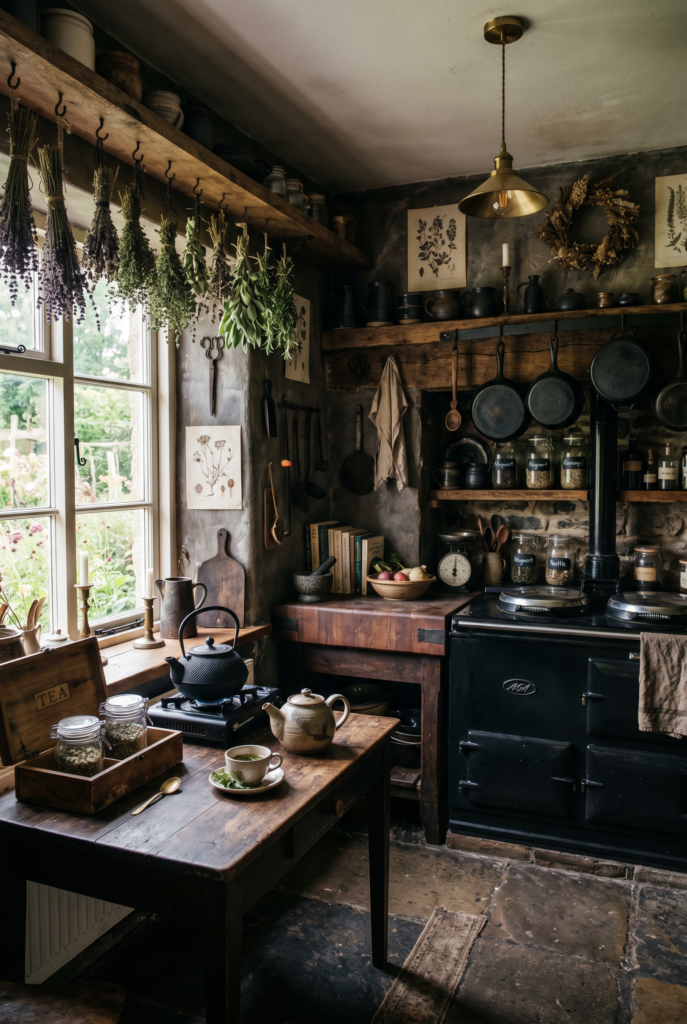
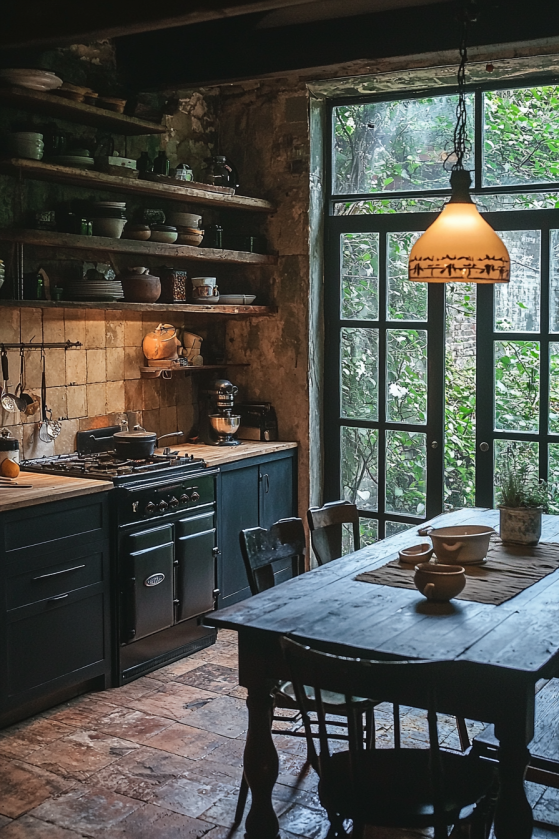
The kitchen where the witch lives does not announce itself. It settles into you slowly — first the scent of dried rosemary and dark wood, then the flicker of candlelight against stone, then the quiet certainty that every surface in this room knows something you don’t.
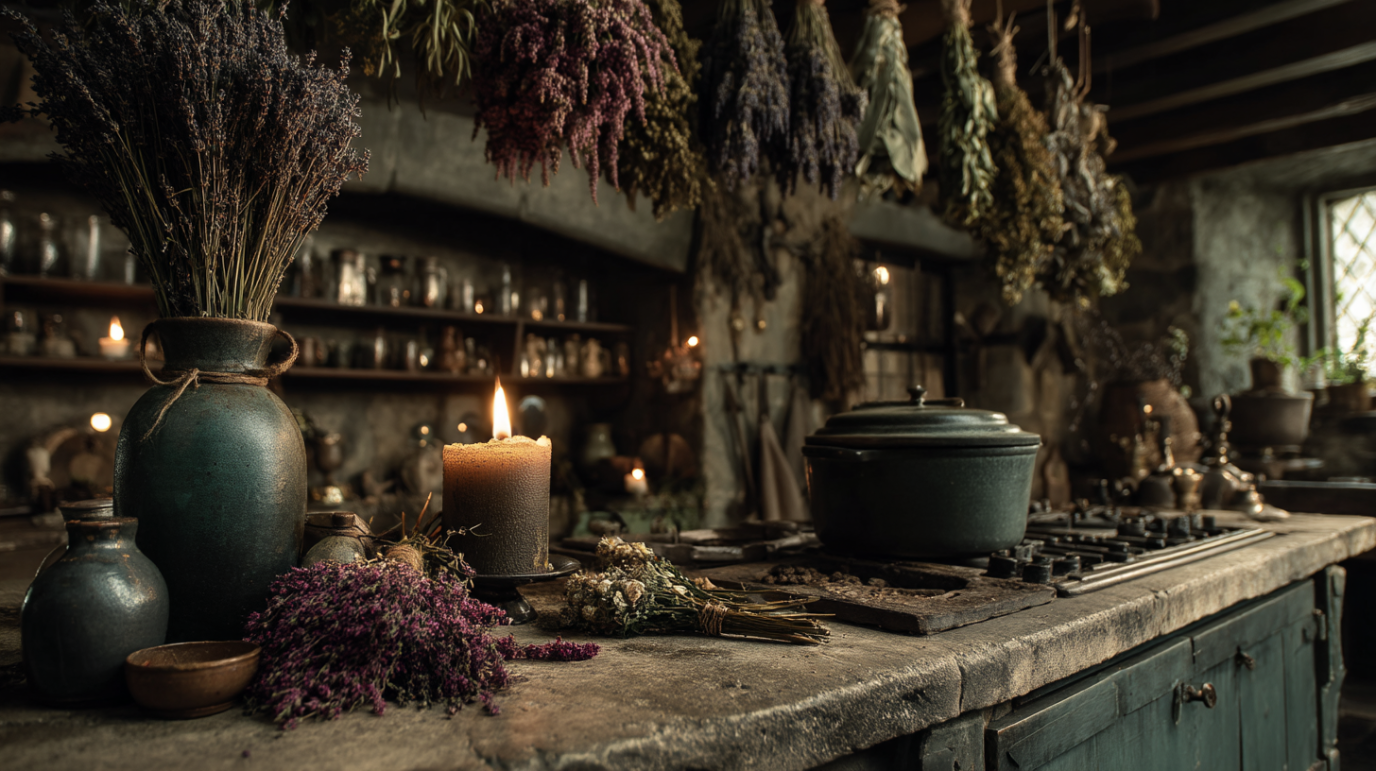
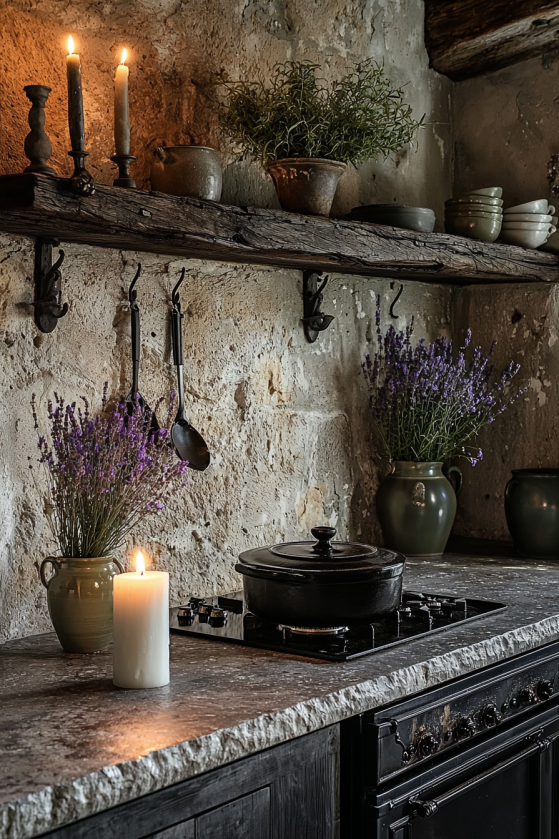
Stone counters that hold candlelight like water. Iron hooks strung with lavender and yarrow. A Dutch oven the color of midnight sitting patiently on the stove, as if waiting to be called upon.
This is cottagegoth kitchen decor: not a trend you layer on top of your life, but a complete world that has always existed — dark, handmade, and deeply intentional — waiting for those who know where to look.
If your kitchen feels too white, too bright, or too modern, this guide was written for you. You don’t need a castle or a farmhouse in the woods. You only need intention, rich texture, darkness used as a design element, and a handful of specific pieces that shift the entire atmosphere of the room.
The cottagegoth kitchen is attainable. It is also — once you truly have it — irreversible.
You will not want to go back.
*This post contains affiliate links. If you purchase through these links, I may earn a small commission at no extra cost to you. I only recommend pieces I genuinely believe in and would use in my own kitchen.*
What Is Cottagegoth Kitchen Decor?
Cottagegoth is the secret marriage of two aesthetics that were always meant for each other.
Cottagecore brings the pastoral romance — dried flowers, handmade ceramics, heirloom plants, and the slow beauty of craft. Gothic adds the shadow: darkness as beauty, ancient materials, drama, and the understanding that ritual lives inside the ordinary.
When these two worlds meet in a kitchen, the result is extraordinary.
A cottagegoth kitchen does not look haunted. It looks inhabited. Inhabited by someone who dries their own herbs, cooks from memory, collects cast iron instead of chrome, and treats the simple act of making tea as something close to ceremony.
The aesthetic is deeply handmade and aged: iron over steel, wood over laminate, stone over composite, dark over pale. Many who arrive here from “dark cottagecore kitchen” searches discover this is the natural next step — the moment the soft pastel pastoral deepens into something older, more serious, and more true.
It sits perfectly between extremes. Unlike gothic maximalism (velvet, grandeur, theatrical excess) or soft cottagecore (light, folkloric, and bright), cottagegoth is practical yet dramatic, warm yet shadowed, domestic yet just slightly otherworldly. It draws from medievalcore and castlecore — the iron, the stone, the candlelight — but brings them into a livable, botanical space that feels like a real home.
Beneath cottagegoth kitchen decor runs an older, quieter current: the kitchen witch tradition.
In folk practice, the kitchen witch turns everyday cooking into quiet ritual. Herbs hung to dry are not merely decorative — they are protection, medicine, and memory. The mortar and pestle is not just a tool, but an instrument of transformation. Every pot simmering on the stove becomes an act of care made visible.
This creates a design language that feels both practical and sacred: counters that resemble working apothecary shelves, dried botanicals that speak of seasons and old knowledge.
It is this deeper sense of purpose and intention that separates a styled dark kitchen from a true cottagegoth kitchen.
If you’ve felt drawn to this aesthetic without quite being able to name why, it is likely the kitchen witch calling you home.
Every cottagegoth kitchen, regardless of size or budget, is built on the same foundation. These are the materials and motifs that carry the aesthetic — the things that, once you introduce them, do the heavy lifting.
Iron
Iron is king. Cast iron skillets left proudly on the stove, wrought iron pot racks overhead, aged iron hooks and pulls — it feels ancient, elemental, and quietly powerful.
Stone
Stone grounds the room. Rough slate counters, stone mortar and pestle, slate trivets — stone holds light differently and gives the kitchen permanence and honesty.
Dark Wood
Dark wood adds warmth. Open walnut or blackened oak shelving, well-loved cutting boards darkened by years of use — it keeps the space from feeling cold.
Dried Botanicals
Dried botanicals bring the magic. Generous, slightly wild bunches of lavender, rosemary, sage, yarrow and dark-centred flowers hung from iron hooks or tucked into vintage crocks — nothing transforms the kitchen faster.
Stoneware & Pottery
Stoneware and pottery in forest green, slate grey, near-black, or deep terracotta. Handmade finishes, irregular shapes, pieces that look like they were fired in a workshop by someone with earth under their nails. These are the vessels the cottagegoth kitchen reaches for daily.
LAYER YOUR OWN COTTAGEGOTH CORE
Start with Cast Iron as your foundation — a heavy Dutch Oven or Skillet left proudly on the stove. Add Stone for grounding (Mortar and Pestle or slate trivets). Bring warmth with Dark Wood shelving and cutting boards. Finish with Dried Botanicals hanging from Aged Iron Hooks and handmade Stoneware in forest green, slate, and terracotta.
Dark Cottagecore Kitchen Color Palette: Slate, Charcoal, and the Dark Spectrum
The cottagegoth kitchen does not commit to absolute black — that would tip into gothic maximalism. Instead, it works within a living spectrum of dark neutrals that feel organic, aged, and drawn from the earth itself.
Slate and Charcoal
These are the foundational tones — the colour of stone, of deep shadow, of the inside of a root cellar in October. They appear on walls, cabinetry, and grout lines. They are the room’s quiet resting state.
Terracotta and Rust
Warmth in a dark palette comes from these earthy accents. A rust-glazed bowl on a dark shelf or burnt orange dried flowers in a crock keeps the space from feeling cold or sterile.
Dark Forest Green
This is the botanical heartbeat — deep sage, hunter green, and near-black greens that carry the weight of old velvet and the garden just outside the window.
Aged Iron Black
Near-black accents — cabinet hardware, iron fixtures, pot racks, and frame edges — are never pure black. Choose aged iron black, the rich finish that looks as though it has absorbed years of woodsmoke and candle soot.
Natural Cream and Linen
Every dark palette needs breathing room. Undyed linen tea towels, cream-glazed ceramics, and a well-loved wooden spoon left on the counter give the eye a place to rest and make the darker tones feel even richer.
Cottagegoth Kitchen Statement Pieces Worth Investing In
A cottagegoth kitchen does not need an expensive renovation. It needs a small handful of high-impact pieces that anchor the entire aesthetic. Invest here first — everything else will follow naturally.
The Cast Iron Dutch Oven
This is the undisputed centrepiece. A dark enamel Dutch oven in deep sage, artichaut, grenadine, or matte black sets the visual tone for the whole room. Leave it on the stove — it cooks beautifully and looks like it belongs there.
The Iron Pot Rack
Ceiling-mounted or wall-mounted, a wrought iron pot rack transforms the kitchen more than almost any other single piece. Cast iron hangs in the air, dried herbs share the hooks, and the room suddenly feels three-dimensional and theatrical.
The Dark Enamel Kettle
A vintage-inspired matte black or deep forest green kettle on the stove or counter acts as the kitchen’s punctuation mark. When the water begins to boil it sounds like rain — a small daily ritual that feels quietly magical.
The Stone Mortar
and Pestle Always on the counter, always suggesting transformation. A heavy granite or lava stone mortar and pestle is both functional and deeply decorative — an ancient object living comfortably in modern daily life.
Gothic Kitchen Open Shelf Styling for the Cottagegoth Aesthetic
Open shelves are the most expressive surface in the cottagegoth kitchen. Style them with intention and the whole room feels like a unified, lived-in world.
Lead with Apothecary Jars
Clear and amber glass jars with cork or metal lids turn pantry staples into a beautiful display. Fill them with dried herbs, whole spices, black lentils, sea salt, and lavender. Label them in a serif or hand-lettered script. A collection of apothecary jars is the visual signature of the kitchen witch shelf.
Layer in Dried Botanicals
Hang generous, slightly wild bunches of lavender, rosemary, sage, yarrow, and dark-centred flowers from the shelf brackets or lay them loosely across the back. The gentle dishevelment is part of the charm.
Mix Heights & Leave Breathing Room
Vary the horizon line deliberately — tall bottles beside low bowls beside bundled herbs. Leave intentional space between objects so each piece can breathe. Overcrowding reads as clutter; thoughtful pauses feel intentional and old.
Add Candlelight
Small votives or pillar candles placed safely on the shelves turn the arrangement into something closer to an altar. In the cottagegoth kitchen, the shelf is always, just a little, sacred.
Witch Kitchen Aesthetic Lighting: Candles, Iron Fixtures, and Pendants
Candles as the Foundation
In the cottagegoth kitchen, candles are not atmospheric extras — they are structural. Thick pillar candles on iron holders, small votives glowing on open shelves, and elegant tapers flickering in wrought iron candlesticks on the counter.
The light they cast moves and breathes. It does something magical to stone surfaces and dark ceramics that no electric fixture can replicate — it makes everything feel truly alive.
Dark Kitchen Aesthetic: Finishing Details That Make It Feel Real
The difference between a cottagegoth kitchen that photographs well and one that truly lives lies in the finishing details. These small, deliberate choices turn a styled room into a living world — the accumulation of a hundred quiet, intentional moments.
The Right Tea Towels
Linen, never terry cloth. Natural undyed linen or cream with deep botanical prints, hung slightly askew on an iron rail. One of the least expensive and most effective touches in the entire kitchen.
Vintage Ceramic Crocks & Pitchers
Old-looking vessels for wooden spoons, spatulas, and utensils. A dark glazed crock or wide-mouthed pitcher feels beautiful and purposeful. Plastic has no place here.
A Worn Wooden Cutting Board
Darkened by years of use or seasoned with oil. Propped against the backsplash or hung from a hook — a working object that has earned its patina.
Dark Soap Dispensers & Dish
Brushes Matte black ceramic, aged metal, or natural wood and sisal. These visible everyday tools signal that the whole room was thought through.
Cookbook Styling
A stack of old, heavy cookbooks with worn spines facing outward, pages marked with slips of paper or dried flowers. Books make the kitchen feel intelligent and lived-in.
The Seasonal Element
A pumpkin in October, holly in December, forced hyacinth in February, or deep burgundy dahlias in September. The cottagegoth kitchen responds gently to the seasons outside.
This post contains affiliate links. If you purchase through these links, I may earn a small commission at no extra cost to you. I only recommend pieces I genuinely believe in and would use in my own kitchen.
These are the specific, high-impact pieces that do the most work when building a cottagegoth kitchen — whether you’re starting from scratch or transforming what you already have.
1. Cast Iron Dutch Oven — Sage, Artichaut or Matte Black The undisputed anchor piece. A deep-toned enamel Dutch oven sets the visual tone for the entire room. Le Creuset and Staub quality is generational — leave it on the stove and it becomes both tool and sculpture.
2. Wrought Iron Pot Rack (Ceiling or Wall Mounted) The single most transformative purchase. Hang your cast iron, patinated copper, and dried herb bundles together. The overhead drama instantly makes the kitchen feel theatrical and complete.
3. Granite or Lava Stone Mortar and Pestle (Large) Always on the counter. Always suggesting alchemy. Heavy, ancient in design, and deeply satisfying to use — this is the object that turns everyday cooking into quiet ritual.
4. Lodge Cast Iron Skillet (10″ or 12″) The everyday hero. Pre-seasoned, durable, and only improves with use. Leaving it out on the stove is not laziness — it’s decoration and proof that this kitchen actually cooks.
5. Amber Glass Apothecary Jars with Cork Stoppers The visual signature of the kitchen witch shelf. Fill them with dried herbs, spices, salt, and botanicals. Label them by hand. Nothing else transforms open shelving faster.
6. Dried Herb Bundle Kit — Lavender, Sage, Rosemary & Yarrow The fastest, most affordable way to shift the entire atmosphere. Hang them generously and slightly wild from iron hooks — the smell and texture alone make the kitchen feel alive.
7. Wrought Iron Candleholder Set — Mixed Heights Pillar and taper holders in wrought iron or matte black. A grouping of three at varying heights creates an altar-like glow that no electric light can match.
8. Dark Enamel Stovetop Tea Kettle Vintage-inspired matte black, deep forest green, or slate. It sits on the stove even when not in use and turns the simple act of boiling water into a small daily ceremony.
9. Handmade Stoneware Ceramics — Forest Green, Slate & Terracotta Beautiful hand-thrown stoneware with reactive glazes and organic, irregular shapes in the signature cottagegoth palette. These pieces have the imperfect, workshop-made quality that makes them feel alive and personal. Use them daily — they only get better with time and love. Perfect for: open shelf styling, everyday tableware, and giving your kitchen that authentic handmade soul.
The Kitchen Becomes the Room You Return To
The cottagegoth kitchen is not designed in a weekend. It accumulates, like all honest aesthetic choices, over time. A Dutch oven here. A bundle of dried sage there. The pot rack that changes everything. The day you finally replace the plastic utensil holder with a dark ceramic crock and feel the whole room exhale.
It is a kitchen built for someone who understands that the daily act of cooking is sacred — that the tools deserve to be beautiful, that beauty is not brightness but depth, texture, shadow, and the particular quality of candlelight reflected in old stone. It is a gothic farmhouse kitchen decor vision in its truest form: not a stage set but a working kitchen that happens to be extraordinary. It is a kitchen that looks like it has always existed, even when you have only just begun to build it.
Start with iron. Start with one piece that carries weight — literally and aesthetically. The rest will find its way to you.
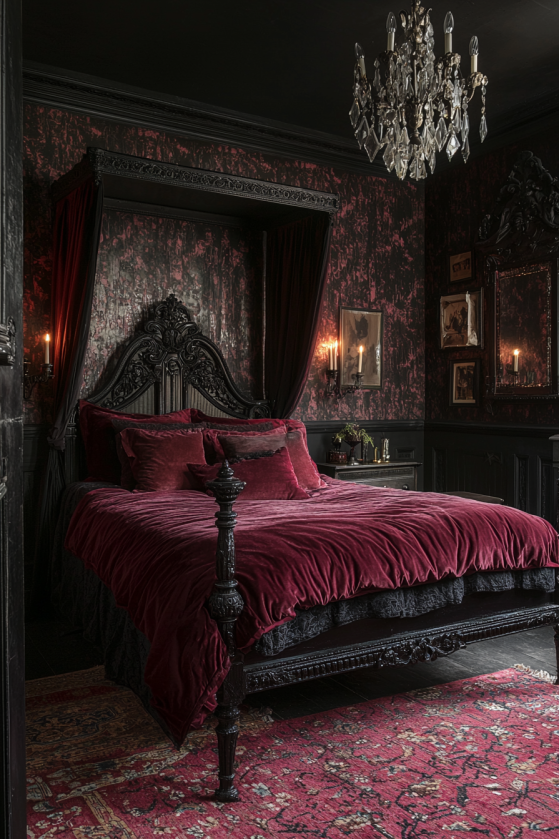
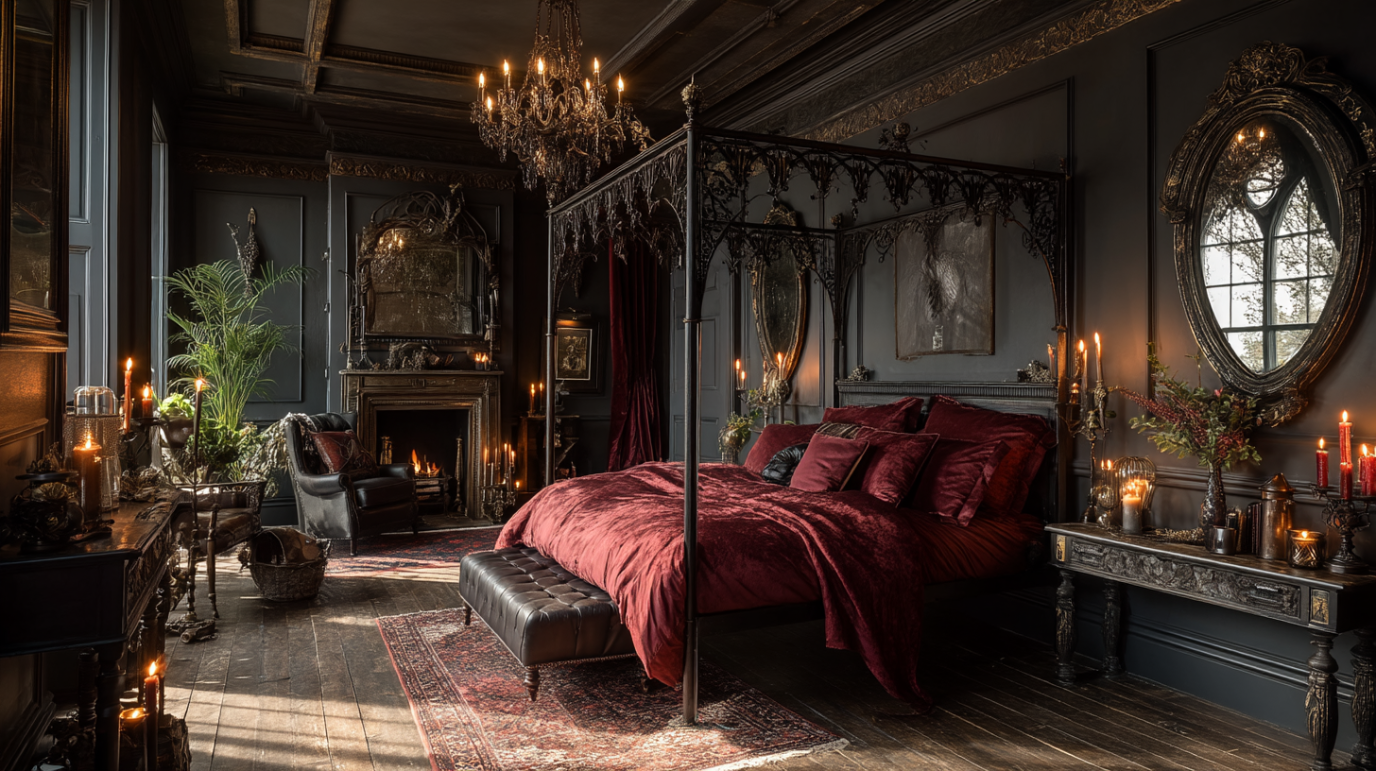
There is a moment, when you push open a door, and the world you left behind simply ceases to exist. Velvet catches the candlelight and throws it in splinters across a ceiling that feels impossibly high. An iron canopy looms above a bed dressed in layers of oxblood and midnight — silk, damask, fabrics you cannot quite name. Baroque mirrors lean against walls so full of art and shadow that every inch whispers a different secret. This is not simply a bedroom. This is a place where the night has become a permanent resident and the morning has been permanently forgotten.
Gothic maximalism is an interior philosophy — one that says more is not excess, it is intention. It layers texture upon texture, story upon story, atmosphere upon atmosphere, until a room ceases to be a room and becomes a world entire. What results is a dark romantic bedroom that feels both theatrical and deeply personal — held together not by rules, but by atmosphere. If you have ever felt the pull of that world — if the image of a bedroom draped like a velvet-curtained theatre stage makes something deep in you feel finally, perfectly seen — then this guide was written for you.
[IMAGE 01 — Placement: After intro. File: gs-gothic-maximalism-bedroom-hero-velvet-canopy-candlelight.jpg]
What Gothic Maximalism Actually Means (And Why It Works)
Gothic maximalism is not gothic minimalism with more candles. It is not maximalism with a skull placed on the shelf. It is its own distinct aesthetic philosophy — theatrical, unapologetic, and steeped in the romantic tradition of finding beauty in shadow, in heaviness, in the weight of things that endure.
Where minimalism strips away, gothic maximalism accumulates — with fierce intention. Every object carries meaning. Every layer of fabric deepens a sensory experience that is opulent but never chaotic. A gothic maximalist bedroom reads like a sentence written in a language you almost know: rich, coherent, deeply considered. This is the moody maximalist bedroom at its most refined — where every surface earns its place and every object carries the weight of intention.
The hallmarks of this aesthetic:
Velvet, damask, brocade — fabrics with depth that absorb light rather than deflecting it
Iron, aged brass, and dark wood — architectural materials with weight and a sense of history
Jewel tones — oxblood, deep amethyst, forest green, midnight navy, pitch black
Drama in scale — towering headboards, floor-pooling drapes, oversized mirrors that double the room’s grandeur
Layering without restraint — textiles over textiles, frames beside frames, candles beside candelabras
Romantic weight — worn edges, tarnished finishes, objects that look as if they have survived centuries and are prouder for it
The goal is not chaos. The goal is abundance that tells a story.
Statement Furniture — The Bones of a Gothic Maximalist Bedroom
Every gothic maximalist bedroom begins with its furniture. These are the bones of the room — and they need to be dramatic enough to hold everything that builds on top of them. Choosing the right gothic bedroom furniture — pieces with the right scale, material, and weight — is where every great gothic bedroom truly begins.
The Bed — The Altar at the Centre of Everything
The bed is the altar. In a gothic maximalist bedroom, this means a canopy bed — ideally iron, ideally with dark finials that curl or spike or taper to menacing points. The canopy creates the feeling of enclosure, of a private world within the room, that is absolutely essential to the gothic interior. Four-poster frames in dark walnut or ebony-stained solid wood are an equally commanding alternative.
Look for iron canopy bed frames with gothic arch detailing, four-poster beds in dark hardwood, or upholstered beds with a tall, arched velvet headboard in deep jewel tones. A gothic iron canopy bed frame in matte black is among the most transformative single purchases you can make — the kind of frame that arrives and immediately makes you feel the room has been waiting for it. Pair it with a velvet headboard in oxblood or dark amethyst for a layered throne effect that anchors the entire space.
Supporting Furniture — Density and History
Dark wood armoires with carved detailing, ornate dressing tables with baroque legs, low chests with iron drawer pulls — these supporting pieces add the density and historical weight that gothic maximalism demands. In this aesthetic, negative space is the adversary. Every surface, every corner, should feel deliberately inhabited.
Layering Velvet, Silk, and Shadow — Mastering Gothic Bedroom Textures
In gothic maximalism, the bed is never simply made. It is staged.
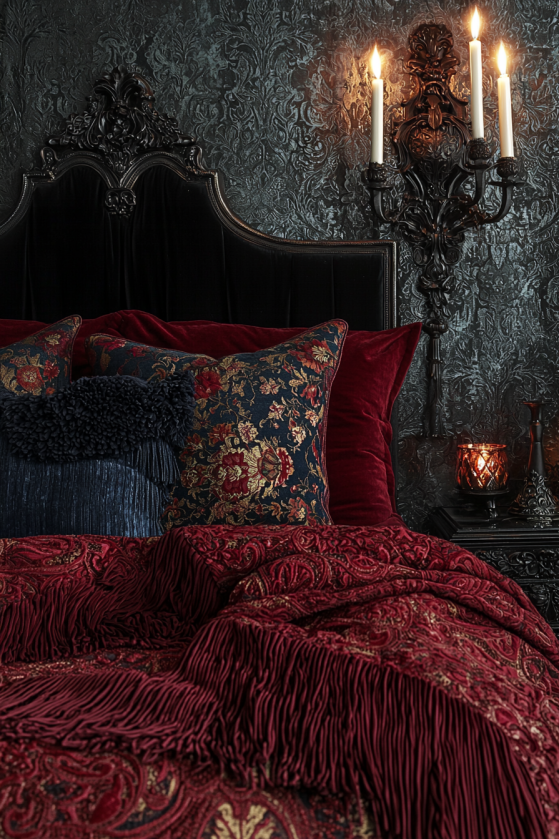
Begin with a base of dark, heavyweight bedding — a duvet cover in oxblood velvet or midnight damask sets the foundation immediately. Layer over it with intention:
A coverlet in a contrasting jewel tone — deep forest green against oxblood, dark amethyst against black — for visual depth at the fold
Euro shams in a complementary fabric: brocade or jacquard with ornate stitching, in a tone that echoes without matching
Accent pillows in jewel-tone velvet — mix sizes, mix shapes, and do not be afraid of height; this bed should look as if it has been accumulating comfort for centuries
A throw draped with studied carelessness — a dark faux fur, a velvet throw, or a hand-knit piece in forest green or midnight blue
At the foot, a blanket chest or tufted velvet ottoman continues the sense of richness beyond the mattress edge
The key to gothic maximalist bedding is weight — both visual and physical. Everything should appear to have gravity. Dark oxblood velvet bedding sets and deep jewel-toned coverlets are the pieces that make this layering feel effortless rather than overdone. Jewel-tone velvet throw pillow sets are among the most high-impact, low-cost changes available in this aesthetic — deep amethyst, forest green, and midnight navy all work beautifully against oxblood or black bedding.
[IMAGE 04 — Placement: After H2. File: gs-gothic-maximalism-bedroom-bedding-oxblood-velvet-jewel-tone-layers.jpg]
Lighting a Gothic Bedroom — Chandeliers, Candelabras, and the Architecture of Shadow
Gothic maximalism does not illuminate. It glows.
The distinction is everything. In a gothic bedroom, lighting is not a function — it is an atmosphere. The goal is warm, pooling light that deepens the shadows rather than erasing them.
The Statement Chandelier
Every gothic maximalist bedroom requires a chandelier. Not a simple drum pendant. Something architectural — a gothic crystal chandelier with dark iron arms and crystal drops that scatter light like shattered glass across the ceiling, or a candelabra-style chandelier with exposed bulbs that mimic the quality of candleflame. The chandelier should feel like theatre rigging dropped from a cathedral.
Size up. In a room with this level of drama, a chandelier that reads as too delicate will be swallowed by its surroundings. Choose something that commands its space.
Candelabras, Table Lamps, and Candlelight
Floor-standing black iron candelabras are among the most transformative objects in a gothic maximalist bedroom — they add height, architectural texture, and a sense of quiet ritual to otherwise dead corners. Pair with real or LED taper candles in black or deep burgundy — the black iron floor candelabra works beautifully with both, making it equally suited to permanent display and occasional evenings of lit atmosphere. The visual impact of a tall iron candelabra in a shadowed corner, half-lit, is worth more than any wall art you could hang in that space.
Bedside lighting should be warm and intimate: antique brass or dark iron table lamps with fabric shades in deep jewel tones, or small iron lanterns placed on bedside tables layered with stacked books, a crystal cluster, and a tarnished silver tray.
[IMAGE 06 — Placement: After H3. File: gs-black-iron-floor-candelabra-gothic-bedroom-corner-taper-candles.jpg]
The Colour Palette of the Night — Choosing Gothic Bedroom Tones
Gothic maximalism is not exclusively black — though black is always the anchor. The palette builds in layers, like a bruise, like the hour just after dusk: deep, complex, alive with colour that reveals itself only up close.
The Core Four:
Black — the foundation. Black walls, black frames, black iron. It absorbs the room into itself and allows everything else to glow against it.
Oxblood / Deep Crimson — the drama. In velvet, this colour vibrates with warmth and threat simultaneously.
Deep Amethyst / Purple — the luxury. On bedding or upholstery, jewel-purple adds the fairytale royalty that gothic spaces crave.
Dark Forest Green — the earthiness. Grounds the palette and prevents it from reading as purely theatrical; adds a gothic garden quality to the room.
Accent Finishes: Aged brass, tarnished silver, and dark walnut stain are the metallic and wood tones that work within this palette. Avoid chrome or bright polished gold — they shatter the atmospheric cohesion immediately.
Wall Colour: Commit to darkness. Deep charcoal, near-black navy, matte black, dark forest green — any of these transforms a room entirely. If you are just beginning to explore dark bedroom ideas, the simplest entry point is wall colour: a single wall in deep matte charcoal transforms a room’s entire atmosphere without requiring a single furniture purchase. For those renting, dark temporary wallpaper in damask or baroque floral patterns achieves the same effect without permanence.
Gallery Walls, Baroque Mirrors, and the Art of the Dark Maximalist Bedroom Wall
In a gothic maximalist bedroom, walls are not backgrounds. They are installations — dense, considered, and impossible to look away from.
The Gothic Gallery Wall
A gothic gallery wall is not a neat grid of coordinated prints. It is a collection — art that appears to have been gathered over time, piece by piece, each one carrying its own history. Think:
Dark oil-style portraits in heavy ornate dark gallery wall frames
Mirrors of different sizes and shapes interspersed between the art, so the viewer’s own reflection becomes part of the collection
The frames are as important as the art itself. Heavy, ornate, dark wood or tarnished gilt with baroque scroll detailing. Consistency of frame quality unifies even the most eclectic collection. Look for sets of ornate carved frames in tarnished gold or dark-painted finishes — grouped sets of three to six pieces ($60–$200) allow you to build the gallery wall foundation without hunting individual frames.
The Baroque Mirror
A single oversized ornate baroque wall mirror can do more work for a gothic maximalist bedroom than almost any other object. Place it above a fireplace, lean it against the wall beside the wardrobe, hang it above the bed. The ornate frame catches the candlelight; the reflection doubles the room’s drama; the scale makes everything feel grander, more theatrical, more impossible.
This is the piece that makes people pause in the doorway.
Velvet Drapes, Canopies, and the Gothic Bedroom Architecture of Fabric
If furniture is the bones of a gothic maximalist bedroom, fabric is the flesh — and in this aesthetic, there should be a great deal of it.
Floor-to-ceiling drapes are non-negotiable. Heavy, jewel-tone velvet curtains in room-darkening fabric — look for floor-length options in midnight black, deep oxblood, or forest green, hung from ceiling-height rods so they pool slightly on the floor. Quality dark velvet drapes are available at a range of price points and will immediately shift the entire atmosphere of the room; they are among the most transformative single-purchase decisions in this aesthetic. The drama of fabric that pools is foundational to the gothic interior — it signals that this room operates outside the ordinary rules of proportion and restraint.
Bed canopies beyond the frame: hang a dramatic canopy of dark fabric from a ceiling hook above the bed for a tent-like, deeply intimate effect. Layer gauze over velvet over silk for dimensional depth. Let it fall loosely rather than being neatly pinned — controlled abandon is the goal.
Rugs: layer them. A large dark-ground Persian or Turkish-style rug as the base, with a smaller sheepskin or faux fur rug layered at the foot of the bed. The layering adds visual richness and the kind of physical warmth that makes a gothic bedroom feel inhabited rather than staged.
[IMAGE 10 — Placement: After H2. File: gs-gothic-bedroom-velvet-drapes-floor-pooling-black-gauze-canopy.jpg]
Gothic Bedroom Finishing Touches — The Details That Complete the World
This is where maximalism becomes maximalism: in the accumulation of deeply considered detail. A gothic maximalist bedroom is finished not when everything has been added, but when removing anything would leave the room feeling poorer for its absence.
Books: Stack them on bedside tables, line shelves, lean them against walls. Dark-spined hardcovers, leather-bound collected works, antique volumes with foxed pages. Books in a gothic bedroom are not storage — they are atmosphere made solid.
Crystals and dark stones: Amethyst clusters, obsidian, labradorite — placed on silver trays, beside lamps, on windowsills. They hold the light differently than anything else and make the room feel like it is conducting something beyond the visible. A dark crystal cluster (amethyst or obsidian works beautifully) placed on a tarnished silver tray creates an instantly curated surface scene.
Dried botanicals: Black-dyed roses, eucalyptus, feathers, skeletal pressed leaves — in dark ceramic vases or hanging dried from shelves. The aesthetic of beautiful things in a state of elegant decay is core to gothic maximalism.
Tapers and pillar candles: Clustered at varying heights, on iron trays, in ornate holders — even unlit, they contribute to the visual richness of the room. Lit, they complete it.
Scent: Burn complex, dark gothic scented candles — oud, black amber, tobacco flower, night-blooming jasmine. A gothic candle in oud or black amber is among the simplest and most effective finishing touches you can add: the scent layer is the detail most often overlooked and most deeply felt. A room that smells of incense and beeswax feels different to walk into than any photograph can convey.
Arranged objects: A tarnished silver tray with rings, dark glass bottles, a velvet pincushion, a key on a ribbon — small objects arranged with care transform a surface into a scene.
[IMAGE 11 — Placement: After H2. File: gs-gothic-bedroom-details-crystals-candles-dark-botanical-antique-tray.jpg]
Affiliate Picks — Shop the Gothic Maximalism Bedroom
This post contains affiliate links. If you purchase through them, I may earn a small commission at no extra cost to you — thank you for supporting GothicSilhouette.
Building a gothic maximalist bedroom is a slow, deliberate accumulation — and these are the pieces worth returning to:
Velvet Headboard in Oxblood or Deep Amethyst — A tall arched velvet headboard is the single fastest transformation available to a gothic bedroom. Look for deep-button tufting and jewel-tone velvet upholstery in oxblood, midnight black, or deep amethyst. Choose at least 54 inches wide for a queen to read as truly architectural — anything narrower loses the commanding presence this aesthetic requires.
Gothic Iron Canopy Bed Frame — A matte black iron canopy frame with gothic arch or finial detailing is the structural centrepiece of the aesthetic. This is a once-and-for-all investment that makes every other choice easier to execute. Investment-tier, typically $800–$2,500 for quality iron frames — everything hangs from this decision.
Dark Oxblood Velvet Duvet Cover Set — The bedding foundation. Look for heavyweight velvet-touch or velvet-backed duvet covers in oxblood (also listed as wine red or deep burgundy on Amazon), pitch black, or deep forest green. A matching sham set in a complementary jewel tone gives instant layering depth with minimal effort.
Jewel-Tone Velvet Throw Pillow Set — Among the highest-impact, lowest-cost additions in this aesthetic. Deep amethyst, forest green, and midnight navy all work beautifully against oxblood or black bedding. Mix sizes and shapes freely — volume and variety are both desirable here.
Ornate Baroque Wall Mirror — An oversized mirror in a carved, tarnished-gold or dark-painted baroque frame. This single piece anchors a gallery wall, amplifies candlelight, and doubles the room’s drama and perceived scale. Larger is always correct here.
Gothic Crystal Chandelier — Dark iron arms, gothic arch or candelabra detailing, crystal drops that scatter light across the ceiling like something broken and beautiful. Choose a size larger than instinct suggests — this room was built to contain it.
Dark Floor-Length Velvet Drapes — Room-darkening, jewel-tone, floor-pooling. Look for midnight black, deep oxblood, or forest green in heavy velvet lined for light control ($150–$400/pair). These drapes will immediately shift the entire atmosphere of the room — the most transformative fabric purchase available for this aesthetic.
Black Iron Floor Candelabra — Tall, architectural, and quietly theatrical. A five- or seven-arm floor candelabra in matte black iron placed in a shadowed corner adds height, texture, and an unmistakable sense of ritual. Works beautifully with both real and LED taper candles, making it equally suited to permanent display and lit evenings.
Ornate Gallery Wall Frame Set — Sets of three to six heavy, carved frames in tarnished gold or dark paint ($60–$200) allow you to build the gallery wall foundation without hunting individual pieces. The consistency of frame quality is what unifies even the most eclectic dark art collection.
Dark Gothic Scented Candle — Oud, black amber, tobacco flower, or night-blooming jasmine. The scent layer is the most overlooked detail in a gothic bedroom and the most deeply felt. A quality dark candle completes the room in a way no photograph can capture.
A gothic maximalist bedroom is not built in a day. It is collected, layered, and slowly inhabited — until the night feels as if it has always lived there with you, comfortable and unhurried, like an old friend who never needed to knock.
Save this post to your Pinterest boards and return to it as your room evolves. Explore more from GothicSilhouette for dark decor inspiration, theatrical interiors, and the quiet art of living beautifully in shadow.
The dark is not empty. It is full of everything worth keeping.
Not the sharp exhale of fresh paint and modern interiors — something older, denser, more deliberate. The smell of beeswax candles and aged velvet, the faint ghost of woodsmoke embedded in centuries of stone. Light catches the edge of a Gilt Mirror and fractures across a ceiling heavy with carved plasterwork. The curtains — plum, pooling, magnificent — shift without wind. Every surface was chosen. Every shadow was placed.
This is the Dark Rococo Aesthetic: Versailles in mourning clothes. Gilded excess stripped of its powdery pastels and draped instead in midnight, oxblood, and forest shadow. Ornate, theatrical, unapologetically maximalist — but grounded in darkness rather than daylight. Baroque home decor in 2026 has found its most theatrical expression in the dark rococo movement. If you have ever stood in a room and felt the architecture speaking to you — the weight of velvet and carved gold and crystal working together on your senses — that is precisely what this gothic home aesthetic is designed to do.
This is not a quick aesthetic. It is not assembled in a weekend. It is built the way the great rooms of the past were built: with intention, with layering, with a willingness to commit to opulence even in the dark. Especially in the dark.
Here is how to design it.
What Is the Dark Rococo Aesthetic?
Dark Rococo is a contemporary interior design style that takes the ornate, gilded excess of 18th-century French Rococo and drapes it in a theatrical dark palette — midnight navy, oxblood, deep plum, and aged gold — to create rooms that feel opulent, jewel-dark, and dramatically atmospheric.
Traditional Rococo was born in early eighteenth-century France: elaborate ornamentation, asymmetry, delicate curves, shell-and-flower motifs, and gilded everything. It was the style of aristocratic excess — Versailles parlors designed to delight and overwhelm. Dark Rococo Velvet Chais keeps that full decorative vocabulary — carved plasterwork, swag drapery, ornate gilt mirrors, crystal chandeliers — but shifts the entire mood into shadow. Where classic Rococo lived in powder blue, blush, and pale gold, Dark Rococo is nocturnal, jewel-rich, and deeply theatrical.
It is not gothic minimalism. It is not Victorian austerity. Dark Rococo does not pare anything back. It layers more — more texture, more ornamentation, more visual drama — but does so in a palette that belongs to candlelight rather than daylight.
The defining tension is opulence that lives in the dark: the chandelier most beautiful when dimmed, the gilt mirror most effective when reflecting only candlelight, the velvet chaise that grows richer in shadow.
If you have been drawn to castlecore or gothic maximalism, Dark Rococo speaks the same architectural language — only with deeper shadow and more decorative ambition.
That tension is the whole point.
The Dark Rococo Color Palette — Shadow, Jewel, and Gold
If traditional Rococo is a room at noon, Dark Rococo is that same room at dusk: the light leaving, the candles being lit one by one, the colors deepening into something richer and more alive.
The palette is built from three registers that must work together:
The Darks
Midnight navy, oxblood red, forest shadow green, deep plum, and near-black. These are the walls, the curtains, and the major upholstery pieces — the grounding layer everything else rests against. Without them, the gilded elements float. With them, everything feels intentional.
The Jewels
Emerald, deep garnet, amethyst, and aged teal. These are the accent upholsteries, throw cushions, and occasional glass or ceramic details. In a dark palette, jewel tones do not shout — they glow. They give the eye something rich to travel toward.
The Gold
Not bright or polished, but aged, slightly tarnished, and warm — the gilt of old frames and carved details. This is the connective tissue that catches candlelight and separates one dark layer from the next.
For paint, consider deep navy or forest shadow greens. For walls with genuine presence, choose dark brocade or damask wallpaper with a subtle gold motif on a black or deep navy ground — it transforms a flat surface into something architectural and alive.
Dark Rococo Furniture — The Stars of the Stage
Every piece of furniture in a dark rococo room should feel as if it was made to be seen. This is not the furniture of practicality. This is the furniture of ceremony — pieces that arrive in a room and immediately announce that the room has intentions. This is rococo interior decor at its most unapologetically theatrical.
The Velvet Chaise or Settee
The centerpiece of the dark rococo living room is almost always a Tufted Velvet Chaise Longue or Settee: carved cabriole legs, rich deep-pile velvet in oxblood, deep plum, or emerald. It should look as if someone very dramatic reclined on it this morning and may do so again this evening. The velvet pile should catch directional light, and the legs should be carved and gilded rather than plain.
An ornate gilt mirror above a fireplace, above a console, or leaned dramatically against a dark wall is the piece that tells the story of the room’s ambitions. Look for genuine carved detail — shell motifs, leaf scrollwork, ribbon and bow flourishes in the true rococo tradition. The frame should feel as if it arrived from a grander past and is patiently waiting for the room to catch up. Seek frames with real carved depth, not pressed resin.
Carved Wood Details and Occasional Seating
Dark-stained carved wood — corbels, cabinet doors, console table legs, and picture frame mouldings — gives the room the architectural weight of old-world craftsmanship. Choose ebonised or very dark walnut finishes with genuine cabriole legs and carved aprons.
A carved bergère or fauteuil-style occasional chair upholstered in jewel-tone velvet turns any corner into its own small theatrical vignette — a quiet moment of drama within the larger performance of the room.
Dark Rococo Wallpaper, Drapery & Architectural Detail
In a dark rococo room, the walls are not a background — they are a surface that participates. The drapery is not decoration — it is theatre. These are among the most load-bearing decisions in the entire room.
Wallpaper as Drama
Dark brocade and damask wallpapers are among the most immediate and transformative choices you can make. Look for gold motifs on black, ivory filigree on deep plum, or rich crimson all-over patterns. A single feature wall re-frames the entire space; floor-to-ceiling application is the more committed — and more rewarding — choice.
Consider painted paneling or dark architectural molding below a picture rail, with textured wallpaper above. This creates natural strata and depth, as if the room has been accumulating beauty over centuries rather than in a single weekend.
Add theatrical depth with heavy, floor-pooling Burgundy Velvet Curtains hung high near the ceiling. Finish with Carved Architectural Moulding or painted panelling to create the sense that the room has been layered over centuries.
Drapery as Theatre
Heavy velvet curtains — floor-to-ceiling, hung high above the window frame and pooling modestly on the floor — are non-negotiable in a serious Dark Rococo room. The quality of the drape matters profoundly. The velvet must have real weight so it moves slowly, hangs without creasing, and pools beautifully rather than bunching.
Choose deep, rich colours: plum, forest green, oxblood, or midnight navy. Trim with gold braid or dark ribbon, hang from a substantial gilded or dark wood rod, and finish with elegant tassel tiebacks — or leave them unbound for maximum drama.
LAYER YOUR OWN DARK ROCOCO DRAPERY
Invest in luxurious Floor-Pooling Velvet Curtains in deep plum, oxblood, or midnight navy — the single most theatrical element you can add to any room.
The last act of a dark rococo room is its light source and its gallery wall — the two elements that pull the entire performance together into something that feels inhabited rather than merely designed. This is where a dark maximalist interior finds its true voice: layered, glowing, and alive in the dark.
Crystal Chandeliers and Candelabras
In a dark room, a crystal chandelier does not merely provide illumination — it makes light. Each droplet refracts and multiplies a single source into dozens of moving specks that dance across walls and ceiling as the air shifts. At low settings (around thirty percent on a dimmer), the effect is genuinely transformative.
For rooms without overhead wiring, use baroque candelabras in brass or dark iron with taper candles. Supplement with candelabras on mantels, consoles, and sideboards. Taper candles in dark or aged brass holders alongside pillar candles at varying heights create the feeling that the room is lit from within, not from above.
LAYER YOUR OWN DARK ROCOCO LIGHTING
Crown the room with a sparkling Crystal Chandelier (maximum droplet density, six to eight arms). Add vertical drama with a Black Iron or Brass Candelabra. Finish with layered candlelight and a thoughtful gallery wall to complete the theatrical glow.
The Baroque Gallery Wall
A dark rococo gallery wall follows a specific internal logic: gilded frames of varying sizes, hung with deliberate asymmetry, on a dark or damask-papered wall. Content options include dark botanical prints, portrait silhouettes or old master-style reproductions, antique maps in gilded frames, or pressed fern and botanical specimens behind glass. The arrangement should read as collected over time rather than purchased at once — even if the planning was meticulous.
LAYER YOUR OWN DARK ROCOCO GALLERY WAL
Build an asymmetrical gallery with Gilded Picture Frames of varying sizes and depths. Fill it with Dark Botanical Prints, old master-style portraits, and antique maps. Unify the look with a shared aged gold finish for that intentional, lived-in drama.
Soft Furnishing — The Last Layer
Baroque-style throw cushions and embroidered pillows are the final flourish that turns a styled room into one that feels inhabited. They suggest someone has just stepped away — leaving behind the same care they bring to everything else.
Look for richly embroidered jacquard weaves, fleur-de-lis or scrollwork motifs in jewel tones, and generous bullion fringe or tassel trim. Velvet, brocade, or heavy silk work best. This is the most forgiving layer in the entire room: the mirror and the settee ask for investment, but the cushions allow for thoughtful curation over time.
LAYER YOUR OWN DARK ROCOCO SOFT FURNISHINGS
Finish the room with luxurious Embroidered Baroque Throw Pillows and tasseled velvet cushions in deep jewel tones. Layer them generously on your chaise, settee, or bergère chair for that final touch of lived-in opulence.
Building the Dark Rococo Room — Where to Start
The room does not have to arrive all at once. The most convincing dark rococo interiors feel as though they grew over time — as though each piece was discovered rather than purchased in one go. This is the gothic rococo home at its most authentic: patient, layered, deeply considered.
A recommended sequence for building from nothing:
Velvet chaise or settee + ornate gilt mirror — The central scene. These two pieces together against a dark wall create the room’s defining statement. Everything else is commentary.
Floor-to-ceiling velvet curtains — The acoustic and visual transformation. The room becomes quieter, heavier, more sealed. This is not a side effect — it is the point.
Wallpaper or dark architectural panelling — A surface that participates rather than retreats. One feature wall or full-room application; both instantly change the room’s identity.
Crystal chandelier installed on a dimmer — The light source that reveals what the other elements have been waiting to show. Do not skip the dimmer.
allery wall, cushions, candelabras, and objects — This is when the room finally becomes yours: specific, curated, and inhabited.
No single piece can substitute for another. But each one, added to the last, creates something that accumulates into a room with genuine atmospheric presence.
The candles can be lit now. The room is not finished when the last piece is placed. It is finished when the last candle is lit — when the chandelier is dimmed, the curtains pool just so, and the light catches the gilt frame at exactly the right angle.
That is the dark rococo promise: not a perfect room, but a felt one.
Affiliate Picks
This post contains affiliate links. As an Amazon Associate and partner, I earn from qualifying purchases at no extra cost to you.
Ornate Gilt Mirror — The anchor piece. Look for carved shell, leaf, or ribbon-and-bow detail in a warm, aged gold finish. The larger the better.
Dark Brocade / Damask Wallpaper — Gold motif on black or deep navy, or a two-colour damask in crimson and black. One feature wall transforms the room.
Crystal Chandelier — Maximum droplet density, minimum six arms, always on a dimmer. This is where the room comes alive.
Baroque Candelabra — Brass or dark iron with taper candles. The accessible alternative to overhead wiring — equally theatrical.
Dark Gothic Art Prints — Botanical illustrations, architectural etchings, and portrait prints in gilded frames. Perfect for building a gallery wall gradually.
There is a particular kind of room that exists in dreams — not in the architectural sense, but in the way certain spaces make you hold your breath when you first step inside. The air feels different: thicker, warmer, charged with the particular sweetness of beeswax candles and old velvet. The light doesn’t illuminate so much as pool, gathering in golden puddles around brass candlesticks, dripping across walls hung with dark, heavy art. Every shadow is intentional. Every corner tells a story.
This is the world of vamp romantic interior design — and in 2026, it has arrived fully realized, unapologetically opulent, and impossibly beautiful.
What Is Vamp Romantic Interior Design?
Vamp romantic interior is Pinterest’s declared aesthetic of 2026: a design sensibility that fuses the dark sensuality of gothic romanticism with the maximalist warmth of jewel-toned Victorian interiors. It is not simply “dark décor.” It is a full emotional experience — rooms that feel like they were designed for candlelit confessions, long winter evenings wrapped in velvet, and mornings so quiet you can hear the candle flames breathing.
The visual language draws from several lineages at once: the theatrical drama of gothic architecture, the lush excess of Pre-Raphaelite art, the deep warmth of dark academia, and the unapologetic sensuality of romantic maximalism. At its core, the vamp romantic interior is a dark maximalist interior philosophy — rooms layered with texture, object, and atmosphere until every element feels earned and every surface tells a story.
If dark romantic bedroom aesthetic has been your search term for years — if you’ve been pinning black iron candelabras and burgundy velvet duvet covers since before it had a name — then vamp romantic interior is the language your instincts have been speaking all along.
The Vamp Romantic Colour Palette
Colour in a vamp romantic interior does not decorate — it speaks. Each hue carries weight, temperature, and intention. The resurgence of oxblood home decor is driving this aesthetic forward — the colour has appeared across velvet headboards, kitchen tiles, front doors, and ceramic objects, and it shows no signs of retreating from its current cultural moment.
The Anchor Darks
The foundational colours are deep, complex, and unafraid of themselves.
Oxblood and deep burgundy are the heartbeat of this palette. Warmer than wine, richer than red, they appear in velvet upholstery, curtain fabric, and accent walls where the light barely reaches. Midnight plum is the darkest note — used in shadow corners, statement headboards, and the backs of bookshelves. It reads almost black in low light and reveals its violet depth by candleflame. Midnight navy grounds the warmer burgundies and plums, creating the tonal contrast that keeps a vamp romantic room from feeling one-dimensional.
Against the anchor darks, warmth notes create the luminous quality that distinguishes vamp romantic from simply gothic.
Candlelight gold and amber appear in metallic accents, gilded mirror frames, brass candlesticks, and warm-toned lighting. Antique ivory and aged cream surface in lace textiles, aged book pages, and delicate trim — the ivory note keeps the palette from becoming oppressive and gives the eye a place to rest. Forest and bottle green is an emerging accent in the jewel tone room decor iteration of this aesthetic: deep emerald velvet cushions, green glass candle holders, the patina of aged bronze.
Textiles and Materials — The Soul of the Vamp Romantic Aesthetic
If colour is the voice, textiles are the body. Nothing defines a vamp romantic interior more than how it feels beneath your hand.
Velvet reigns supreme. Not flat synthetic velvet, but rich, deep-pile velvet that shifts colour when brushed and catches candlelight in liquid pools. Floor-to-ceiling Velvet Curtains, velvet headboards, and jewel-toned Velvet Throw Pillows are non-negotiable..
Silk and satin add dangerous shimmer. Brocade and jacquard bring bold pattern. Lace provides the perfect fragile contrast against the heavier fabrics.
Lighting — The Magic of Vamp Romantic Interior Atmosphere
There is no aspect of vamp romantic decor more critical — or more frequently misunderstood — than lighting.
The vamp romantic interior never uses overhead lighting as its primary source. Instead, it is built on layered, flickering warmth: candlelight, firelight, low lamps, and warm fairy lights woven through dark greenery.
Candelabras are non-negotiable. Tall black iron candelabras with multiple arms create the vertical drama this aesthetic craves — placed on sideboards, mantels, or beside a chair where the flame dances and casts moving shadows..
Dark crystal and jewel-toned glass act as light multipliers. A single dark amethyst or ruby glass candle holder can transform one flickering tea light into an entire atmosphere. Crystal chandeliers — especially those with dark or coloured crystals — scatter candlelight across ceilings and walls in shifting, magical patterns that no modern LED can replicate.
LAYER YOUR OWN JEWEL-TONED CRYSTAL GLOW
Bring the magic home with Amethyst Crystal Candle Holders, rich Ruby Crystal Candle Holders, and dramatic Smoky Crystal Candle Holders. Finish with a stunning Dark Crystal Chandelier and warm 2700K bulbs in any electric fixtures to preserve the deep, flattering glow this aesthetic demands
The Bedroom — Sanctuary of the Vamp Romantic Interior
If you are building a vamp romantic interior and can only start with one room, begin here.
The vamp romantic bedroom is a private sanctuary — enclosed, warm, and intimately dramatic. The bed is the altar. A tall, Dark Velvet Tufted Headboard (ideally floor-to-ceiling) sets the dominant vertical presence. Layer the bedding with intention: a rich Velvet Duvet Cover Set in deep plum, oxblood, or burgundy as the foundation, then build depth with Jewel Tone Velvet Throw Pillows in sapphire, amethyst, ruby, and emerald.
Velvet Curtainsare non-negotiable. Choose heavy, floor-length panels in deep burgundy or oxblood that pool generously on the floor. Hang them high near the ceiling for maximum drama and shadow.
For the walls, go with a single feature wall in midnight plum or oxblood, or add Dark Floral Damask Wallpaper for instant atmosphere.
The Living Room — Theatre in Your Vamp Romantic Home
The vamp romantic living room is not a room you simply sit in. It is a room that performs.
Every space needs a strong focal point: a fireplace, a statement sofa, a gallery wall, or dramatic window treatments. Whatever you choose must be theatrical in scale and rich in texture.
The hero piece is almost always a low, generous Tufted Velvet Chesterfield Sofa or channel-back sofa upholstered in deep plum, midnight navy, or oxblood velvet — the kind that invites you to sink in and stay until the candles burn low.
Gallery walls follow a clear logic: oversized art in dark lacquer, antique brass, or aged bronze frames featuring romantic oil-style portraits, dark botanical illustrations, or dramatic abstracts in burgundy and gold.
Finish with Layered Dark Rugs — a deep Persian or oriental style in rich reds and navy — to add warmth and drama underfoot.
LAYER YOUR OWN VAMP ROMANTIC LIVING ROOM
Anchor the space with a luxurious Tufted Velvet Chesterfield Sofa. Add drama with an Ornate Gallery Wall of dark framed art. Complete the theatre with Layered Persian Rugs and glowing candlelight.
Accessories and Styling — The Details That Tell Your Vamp Romantic Story
In a vamp romantic interior, the accessories are not afterthoughts. They are the punctuation marks in a sentence that only fully lands when read complete.
Dark florals and botanicals bring melancholic beauty to the vamp romantic interior. Dried Black Roses in black iron vases, burgundy peonies in aged brass urns, or clusters of dried hydrangeas in deep aubergine create that slightly past-its-peak romance.
Books are displayed with intention — stacked by height on dark wood surfaces or arranged by spine color in tonal sequences of burgundy through midnight. Weathered hardcovers with patina add layers of story and depth.
The Sideboard or Console Table holds the evening in place. Dark crystal decanters catching the candlelight from two black iron candlesticks of different heights. A cluster of dried dark roses in a matte black vase that remembers when they were burgundy. Above: an ornate carved mirror reflecting everything back warmer than it arrived. The vamp romantic interior lives in its details
Mirrors are among the most powerful (and overlooked) investments. Choose dark-framed, ornate, and oversized — a floor-length baroque mirror in aged black or antique gold multiplies candlelight and makes the room feel endless.
Aged and antique objects complete the story: darkened brass candlesticks, crystal decanters, and silver-framed sepia photographs. The patina of objects that have lived gives the space its soul.
Shop the Look — Your Vamp Romantic Interior Affiliate Picks
These are the pieces that anchor the vamp romantic decor aesthetic — chosen for their design quality, atmospheric impact, and long-term value in a dark romantic home. Ordered by the pieces that transform your space fastest.
Affiliate disclosure: Some links below are affiliate links. We may earn a small commission at no extra cost to you. We only recommend pieces we genuinely love and that serve the aesthetic.
1. Dark Crystal Candle Holders | $30–60 A cluster of faceted crystal candle holders in amethyst, ruby, or smoky crystal turns a single tea light into pure atmosphere. Place three at different heights for shifting, jewel-toned glow.
2. Black Iron Multi-Arm Candelabra | $45–120 The ultimate vertical drama piece. A 3-arm or 5-arm wrought iron candelabra creates moving shadows and warm candlelight that makes velvet and dark walls come alive.
3. Jewel-Tone Velvet Throw Pillow Set | $40–90 A set of 3–5 velvet pillows in oxblood, midnight plum, and deep emerald instantly layers opulence on any bed or sofa. The pile catches candlelight beautifully.
4. Dark Plum Velvet Bedding Set | $80–150 The foundational layer for the vamp romantic bedroom. Deep-pile velvet duvet and pillowcases in plum, oxblood, or burgundy ground the entire space.
5. Deep Burgundy Velvet Curtains — 108-Inch Panels | $60–140 Heavy, floor-pooling velvet curtains in rich burgundy or oxblood are the single most transformative purchase in this aesthetic. Hang high and let them drape generously.
6. Dark Maximalist Framed Wall Art | $35–85 Oversized pieces in ornate dark or gilded frames — dark florals, romantic oil-style portraits, or moody landscapes — bring theatrical storytelling to your gallery wall.
7. Dark Ornate Mirror | $120–350 The most powerful (and often overlooked) piece. An arched or baroque mirror in aged black or antique gold multiplies candlelight and makes any room feel endless.
Vamp romantic interior design is a 2026 Pinterest aesthetic that blends gothic romanticism with maximalist Victorian warmth. It uses deep jewel tones — oxblood, midnight plum, sapphire — heavy velvet textiles, layered candlelight, and intentional shadow to create rooms that feel opulent, intimate, and theatrically beautiful.
What colours are used in vamp romantic decor?
The vamp romantic colour palette centres on deep anchor darks: oxblood burgundy, midnight plum, and navy. These are warmed by candlelight gold, antique ivory, and emerging accents of bottle green. The unifying quality is depth — every colour has weight and complexity in low, candlelit light.
How do I start a vamp romantic bedroom on a budget?
Start with textiles, not paint. A pair of deep velvet curtains hung high changes how a room reads more than almost any other single purchase. Add a black iron candelabra and a cluster of dark crystal votives. A velvet throw at the foot of an existing bed. These three moves — curtains, candelabra, votives — create the foundational atmosphere of the vamp romantic interior without requiring renovation.
What is the difference between dark romantic and gothic decor?
Gothic decor leans architectural — pointed arches, gargoyles, stone, overt symbolism. Dark romantic decor (of which vamp romantic is the 2026 peak expression) is warmer and more sensory: velvet, candlelight, dried roses, and jewel tones create intimacy rather than grandeur. Vamp romantic interior is gothic in its darkness but romantic in its warmth — beautiful where gothic can be austere.
How to Begin — Building Your Vamp Romantic Interior Layer by Layer
The most important thing to understand about the dark fairytale aesthetic is that it is built in layers. You do not need to renovate. You do not need to repaint every wall — though a single deep-painted feature wall helps enormously. You begin with the textiles, because they carry the most visual weight.
A pair of deep velvet curtains hung high on an otherwise plain bedroom wall changes everything about how the room reads. Add a black iron candelabra on a bedside table. A cluster of dark crystal votives. A velvet throw folded at the foot of the bed [AFFILIATE PLACEHOLDER: Plush velvet throw blanket — dark plum, oxblood, or midnight navy, soft and weighty, 50×60 or 60×80 inches — an affordable entry point to the aesthetic]. These small moves, accumulated with intention, begin to speak the visual language of the vamp romantic interior.
This is the gothic cozy aesthetic at its finest: rooms dark enough to feel like sanctuary and warm enough to feel like home. It asks nothing of your square footage and everything of your sensibility.
Close your eyes for a moment and imagine the room. The air is warm with beeswax and something faintly floral — dried roses, perhaps, left a little too long and more beautiful for it. The velvet curtains have fallen shut and the last of the afternoon light filters through them in a bruised, plummy glow. Somewhere in the room, a candle is burning.
This is the vamp romantic interior. It has been waiting for you.
Save this post to your dark home decor Pinterest board and explore the full aesthetic universe at shadowcottage.com. Shop all seven affiliate picks above — each one chosen with the same obsessive attention to atmosphere that built this room.
There’s a moment when you step into a room that’s been intentionally, unapologetically made dark… and the whole world outside the door just fades away.
You feel it before you even see it — the hush of heavy velvet brushing against stone, the warm flicker of candlelight dancing across crystal and gold, the quiet weight of history wrapping around you like a favorite cloak.
This isn’t just a pretty room. This is a room that makes a promise.
This is castlecore interior decor — gothic at its most romantic and opulent. Not a passing trend, but a full commitment to drama, beauty, and that deliciously moody atmosphere that makes you feel like the main character in your own dark fairytale.
The world is finally catching up. With Wuthering Heights back in the spotlight and dark romantic interiors trending everywhere, the dark fairytale room is no longer a niche fantasy — it’s the direction design is moving.
The question isn’t whether you should answer the call. It’s how you’ll answer it with your own theatrical conviction.
Pull up a velvet chair, light a few candles, and let’s create your version.
Shop This Look: Castlecore Grand Room Vibes
Heavy Velvet Curtains in Deep Plum or Burgundy
Tufted Velvet Armchair or Sofa
Red or Purple Tufted Velvet Ottoman
Ornate Brass or Black Candelabra
Large Medieval-Style Wall Tapestry
Crystal or Iron Chandelier
Carved Dark Wood Console or Sideboard
Antique-Style Gilded Mirror or Framed Portrait
What Is Castlecore? The Aesthetic That Woke Something Ancient
Castlecore is the interior design aesthetic that pulls straight from medieval and Gothic European architecture — stone walls, tapestried halls, arched windows, and rooms bathed in soft candlelight — and reimagines it for real, modern homes.
It’s the love child of Gothic architecture and Romantic literature. It draws from the same deep well as Brontë, Poe, and the Pre-Raphaelites. The result is maximalist without feeling chaotic, dark without ever feeling cold, and historical without being stuffy or museum-like.
The aesthetic lives at the intersection of:
Romantic literary aesthetics — the brooding, the sublime, the achingly and dangerously beautiful
Medieval opulence — rich tapestries, heavy luxurious textiles, wrought iron, and hand-carved wood
Dark fairytale romanticism — thorned roses, midnight color palettes, and that irresistible candlelit drama
And right now, the cultural winds are blowing strongly in its direction. The vamp romantic interior trend is exploding, and it overlaps almost perfectly with castlecore.
This is not the moment to be timid. This is the moment to lean all the way in.
Shop This Look: Castlecore Essentials
Heavy Velvet Curtains in Deep Plum or Burgundy
Tufted Velvet Armchair or Sofa
Large Medieval or Floral Wall Tapestry
Ornate Wrought Iron Wall Sconces
Tall Iron Floor Candlestick / Candelabra
Carved Dark Wood Bench or Console Table
Preserved or Artificial Dark Red / Plum Roses
Brass or Iron Candelabra
Patterned Vintage-Style Area Rug
Ornate Brass Skeleton Key or Decorative Key
The Architecture of Shadow — Walls, Texture, and Foundation
Every castlecore interior decor begins with its walls. You cannot quarry limestone from the Cotswolds, but you can achieve something that speaks the same language: depth, texture, weight, and unapologetic darkness.
The Moody Wallpaper Approach
For renters, for rooms where permanent alteration is not possible, or simply for those who want the most dramatic transformation with the least destruction, a high-quality, atmospherically printed wallpaper is the most powerful single investment you can make.
The Moody Wallpaper has quietly become a castlecore institution; it is a community arriving at the same aesthetic revelation. The deep, layered print reads as something that has absorbed candlelight for centuries. In photographs, it creates an immediate sense of place, of history, of a room with a story it hasn’t finished telling.
One wall is often enough. Anchor the room’s darkest element to a single statement surface — the wall behind the bed in a dark fairytale bedroom, or the wall against which a tapestry will ultimately hang — and let everything else in the room build toward it.
Paint and the Gothic Palette
If you’re painting, step into the color world of the Romantic painters: midnight blue, near-black, aged garnet, deep plum, forest green that has forgotten what sunlight looks like.
And do not fear a ceiling in the same shade as your walls. A monochrome dark room reads as something enveloping, something total — as if the room itself has claimed you.
The Art Of Stenciling – The art of stenciling lets you hand-craft intricate gothic damask, thorny botanical vines, medieval heraldic motifs, and whispering moon-phase borders that feel like they’ve been there for centuries. Stenciling Supplies
Deep Plum Limewash and Candlelit Arched Alcoves
Nothing transforms ordinary walls into centuries-old dark fairytale magic quite like limewash.
This ancient, breathable paint (made from slaked lime) creates the softest, most romantic textured finish imaginable. It catches candlelight in the most beautiful way — shifting and glowing as the light moves — and gives your room that lived-in, centuries-old castle feeling without ever looking flat or modern.
Choose deep plum, off-black, or rich burgundy limewash and watch how the walls seem to breathe and come alive in the evening.
The technique is delightfully simple (no heavy prep required on most surfaces), and the result feels like pure castlecore magic.
Deep Plum or Burgundy Limewash Paint
Off-Black or Charcoal Limewash Paint
Limewash Paint Kit with Brushes & Sealer
Ornate Iron Lantern Wall Sconce
Carved Wooden Armchair or Accent Chair
Black or Gray Faux Fur Throw Blanket
Tall Iron Floor Candlestick or Candelabra
Dried Floral Arrangement or Preserved Roses
Arched Window Mirror or Gothic Mirror
Textiles as Theatre — Velvet Curtains, Tapestries, and the Art of the Draped Room
IIf the walls are the bones of a castlecore room, the textiles are the flesh, the warmth, and the living proof that someone magnificent lives here.
In castlecore, fabric doesn’t whisper — it declares.
Velvet Curtains — The Non-Negotiable
There is no true castlecore room without velvet curtains. Let that be understood.
We’re talking floor-to-ceiling, 108-inch lengths that pool ever so slightly on the floorboards. That extra weight and drape creates real architectural drama and instantly makes the ceiling feel taller.
Deep purple (or rich burgundy) or Dark Forest Green velvet are the gold standard. In this shade, the curtains carry both gothic mystery and regal elegance — the same color you see in medieval court paintings and the robes of queens who knew power could also be breathtakingly beautiful.
When late afternoon light filters through and the velvet shifts from violet to near-black in the folds, you’ll understand exactly why this piece is non-negotiable.
Shop This Look: Velvet Curtains & Castlecore Textiles
108-Inch Floor-Length Velvet Curtains in Deep Purple or Burgundy
08-Inch Floor-Length Velvet Curtains in Forest Green
Extra-Wide Velvet Curtain Panels
Blackout Velvet Curtain Liner
Ornate Curtain Rods in Antique Brass or Black IronLarge Floral or Medieval-Style Wall Tapestry
Luxury Faux Fur or Velvet Throw Blanket
The Medieval Castle Tapestry — Instant History
The second most powerful textile in any castlecore room is the tapestry.
For over a thousand years, wall tapestries were the heart of castle interiors. They kept stone walls from feeling cold, told stories in thread, and announced to everyone who entered that the person who lived here had history, taste, and a story worth telling.
Hung against a deep, dark wall, a tapestry does something no framed print ever can — it reads as woven time. It adds instant soul, texture, and that quiet sense of “this room has always been here.”
One large tapestry can completely transform a plain wall into something that feels centuries old. Pair it with a simple dark wood bench, a few velvet pillows, and soft candlelight, and you’ve created a moment that feels like it belongs in a gothic romance novel.
Shop This Look: Medieval Tapestries & Bench Styling
Large Medieval or Floral Wall Tapestry
Large Landscape or Historical Wall Tapestry
Dark Wood Bench or Rustic Console Table
Velvet Bench Cushion or Daybed Cushion
Assorted Dark Velvet Throw Pillows
Tall Iron Floor Candlestick or Candelabra
Wrought Iron Wall Sconce
Dried or Artificial Deep Red Roses
The Maximalist Textile Edit
Castlecore is never a minimalist’s aesthetic — and it never pretends to be.
This is the moment to layer like you mean it. Drape a lush faux-fur throw over a velvet chaise. Stack embroidered cushions in rich jewel tones until you could almost lose yourself in them. Consider a canopy above the bed (or chaise) — lengths of dark gauze or heavy velvet suspended from a simple ceiling hook, pooling dramatically and creating a room within a room.
Every textile should feel as if it was collected over time, inherited from a mysterious relative, or discovered in the locked back room of an old manor you weren’t supposed to enter.
Shop This Look: Maximalist Textiles & Layered Luxe
Luxury Faux Fur Throw Blanket
Tufted Velvet Chaise Lounge or Daybed
Embroidered Jewel-Tone Velvet Throw Pillows
Dark Velvet Canopy Bed Curtains or Ceiling Drapes
Heavy Velvet Curtain Panels
Patterned Velvet Pillow Covers
The Dark Fairytale Bedroom — Where Dreams Turn Gothic
The castlecore bedroom is never just a place to sleep.
It is a place to disappear — into velvet, candlelight, and stories that feel centuries old.
It all begins with a bed that makes a statement. A four-poster frame in dark stained oak or wrought iron, or a low platform bed set against a dramatic tufted headboard in oxblood leather or midnight velvet. The frame should feel like it was here long before you — as if the room was built around it and you are simply the newest chapter in its story.
The Canopy and the Darkness Above
Now add the final touch of magic: suspend a canopy of dark gauze or heavy velvet over the bed, letting it fall from a ceiling hook or from the four-poster frame itself. In candlelight (or the soft glow of a shaded lamp), the effect is total. The bed becomes its own private world — a room within a room, a gothic sanctuary suspended in shadow.
Shop This Look: Dark Fairytale Bedroom
Four-Poster Bed Frame
Velvet Bedspread or Comforter
Dark Gauze or Velvet Canopy Curtains
Embroidered Velvet Throw Pillows
Large Beeswax or Dripping Pillar Candles
Ornate Brass or Iron Candlestick Holders
Ceramic or Black Vases
Luxury Faux Fur Throw
The Dark Fairytale Colour Palette
This is where castlecore dreams turn fully gothic, and where you get to write your own fairytale every single night.
Restrict the bedroom palette to three or four tones and let them govern everything: near-black as the dominant, a deep jewel tone (midnight blue, forest green, plum, garnet) as the secondary, aged gold or burnished bronze as the metallic accent. These tones together create the sensation of a room that has always existed in a state of permanent candlelit evening — a room that does not need the sun.
Light as Ceremony — The Red Crystal Candelabra and the Castlecore Art of Illumination
Nothing destroys castlecore interior decor faster than bright, flat overhead lighting. And nothing elevates it more absolutely than treating light as ceremony.
In a real castle, light came from fire — from torches, hearths, oil lamps, and candles that guttered in draughts. Your modern room will use electricity. But the quality of light should honour the source: warm, directional, multi-sourced, and theatrical.
The Candelabra as Crown Jewel
A red crystal candelabra is one of the highest-converting castlecore accent pieces for a reason as simple as it is true: it does exactly what it promises. The crystal refracts light into small fires across every wall in the room. The red tones shift from garnet to blood orange depending on the warmth of the bulb. It reads as deeply theatrical in photographs.
Place it on a dining table for maximum drama, on a fireplace mantel as a centerpiece, or on a deep window ledge where it can cast red light against velvet curtain fabric at dusk.
Layered Light — The Castlecore Rule
Multiple low sources always over a single overhead. The formula:
Wall sconces at below-eye level, with amber or warm white bulbs, flanking mirrors, tapestries, or archways
Table lamps with darkly coloured shades — forest green glass, black fabric, deep burgundy — casting downward, intimate pools of light
LED candles in gothic iron holders, grouped in odd numbers on mantelpieces and coffee tables
A statement chandelier — dark iron or black crystal — as a sculptural ceiling anchor, never as the room’s primary light source
The effect of multiple low light sources is a room that seems to breathe. Shadow and light in constant, quiet conversation.
Vamp Romantic Interior Meets Dark Rococo Aesthetic — The Philosophy of Castlecore Maximalism
The dark rococo aesthetic pushes further still: the ornate, gilded, curvaceous excess of 18th-century French court design filtered through a darkened lens. Instead of pale gold and cream, imagine black lacquer and aged brass. Instead of pastoral scenes in gilt frames, imagine oil paintings of storms, ravens, and roses on the very edge of dying.
How to Merge Vamp Romantic and Castlecore
The real magic happens when you let vamp romantic and castlecore dance together in the same room.
This is where gothic maximalism feels alive — rich, emotional, and deeply personal. It’s not about following rules. It’s about creating a space that feels like it has a heartbeat.
Here’s how the two aesthetics weave together so effortlessly:
Small Gilded Accents that catch the light: ornate candleholders, crystal vases in garnet or midnight blue, and jewelled bookends on shelves overflowing with leather-bound books.
Do not curate obsessively. Do not edit toward minimalism. Maximalism earns its name by having the courage of its own excess.
Shop This Look: The Small, Magical Details
Glass Cloche / Bell Jar with Brass Base
Small Ornate Gilded or Aged Black Picture Frame
Cut Crystal or Textured Glass Candle Holder / Votive Holder
Antique-Style Leather-Bound Book Set
Preserved or Artificial Deep Purple / Black Roses
Black Taper Candles (dripping style)
Ornate Iron or Brass Candlestick Holder
Raw Amethyst or Purple Crystal Chips in Small Glass Bottle
Decorative Pinned Moth or Entomology Specimen
Deep Red or Burgundy Velvet Fabric Scraps
Tri-fold Picture Frames
Affiliate Picks — Shop the Castlecore Edit
Every product below has been chosen for its dark, dramatic beauty and its proven performance in the castlecore aesthetic. Affiliate links included — your purchase supports this space at no cost to you.
1. DarlingHouseDesign Moody Wallpaper — Etsy Listing 1780313902 With 7,875 favourites, this is the wall anchor your castlecore room has been waiting for. The deep, textured botanical print reads as something ancient in photographs — perfect for a statement wall in a dark fairytale bedroom or gothic maximalist living room. Tones shift from near-black to deep layered plum depending on the light. The single most powerful first investment for the castlecore aesthetic.
2. Medieval Inspired Castle Tapestry — The Statement Textile That Transforms a Room
This is the single most powerful textile in castlecore.
A large medieval-inspired wall tapestry doesn’t just decorate a wall — it transforms it. Whether you hang it behind your bed, above a fireplace mantel, or on the longest wall in your living room, it instantly adds texture, narrative weight, and that sense of woven history no framed print can ever replicate.
Botanical themes (like the rich floral design in the image) are especially perfect for castlecore because they feel both romantic and slightly wild — exactly the balance we love.
One oversized tapestry can carry an entire corner or even an entire room. Pair it with a simple dark wood bench or chaise, a few velvet pillows, and soft candlelight, and you’ve created a moment that feels like it belongs in a gothic romance novel.
Shop This Look: Medieval & Botanical Tapestries
Large Medieval Floral Wall Tapestry
Large Landscape or Garden Scene Tapestry
Dark Wood Bench or Rustic Console Table
Deep Plum or Burgundy Velvet Throw Blanket
Embroidered Jewel-Tone Velvet Throw Pillows
Wrought Iron Wall Sconce or Tall Floor Candlestick
Dried or Artificial Dark Red Roses & Greenery
Vintage-Style Area Rug
3. Deep Burgundy Velvet Curtains The non-negotiable textile investment for any castlecore space. Velvet Long Style Curtain Castlecore Colors, genuine architectural drama. Deep purple shifts from violet to near-black depending on light direction — a living textile, never static, always theatrical. Pair with a matte black curtain rod for maximum effect.
4. Crystal Candelabra — Crystal Candelabra with Red Candelas. The highest-drama, most-photographed accent piece in the castlecore toolkit. The crystal refracts warm light into fractured fire across any dark wall — a quality that photographs magnificently and performs even better in person. Once seen lit in a darkened room, returning it rch Amazon: “red crystal candelabra”)
5. Gothic Wrought Iron Wall Sconces For castlecore lighting that genuinely honors the spirit of torchlight. Dark iron, candle-style bulb holders, the right balance of ornate detail without tipping into kitsch. Mount on either side of a tapestry, mirror, or alcove for cinematic effect.
6. Dark Floral Embroidered Velvet Pillow Covers The layering element that completes any castlecore sofa or bed. Velvet Embroidered Pillows In Jewel Tones. Look for deep jewel tones in velvet or brocade with embossed Gothic floral detail. Stack in odd numbers, mix textures freely. The details that make a room feel inhabited, collected, and genuinely loved. (Search Amazon: “dark floral embroidered velvet cushion covers”)
The room you have been imagining — the one draped in velvet and lit by crystal, where darkness is not absence but presence, where every surface carries the weight of a story — is not a fantasy. It is a series of deliberate choices, made one at a time, with a clear understanding of the aesthetic’s logic and the courage to commit to its beauty without apology.
Start with the walls. Let the texture speak first.
Then the velvet. Curtains first, cushions after.
Then the light. Candelabra, then sconces, then candles in iron.
Then the tapestry, and the mirror, and the roses half-open in their dark vase.
The castle does not arrive all at once. But it arrives. And when it does, you will stand in the doorway and feel the air change.
Save this guide to your dark aesthetic Pinterest board and explore @GothicSilhouette for more castlecore interior decor inspiration, dark fairytale bedroom ideas, vamp romantic interior styling, and gothic maximalist living room guides. Every pin links back here. Every image is a door.